Shade Structures for Turf Fields: A Commercial Buyer’s Guide
Synthetic turf fields solve a lot of maintenance problems for school districts, municipal parks departments, and sports complex operators. But they create a different problem entirely: heat. A synthetic turf field can run far hotter than natural grass on the same afternoon, and that surface heat does not stay on the field. It radiates up into every player, coach, referee, and parent standing anywhere near it. Shade structures for turf fields are becoming a standard line item in new field construction and in capital improvement plans for existing complexes, not because anyone expects to shade an entire 80,000-square-foot playing surface, but because targeted shade at the sideline, the bench, and the spectator areas is where the heat-safety payoff actually happens.
This guide is written for the people who have to make that call: athletic directors, parks and recreation facility managers, school district operations staff, and the architects and engineers who draft the capital plan. It covers why these fields run hot in the first place, why covering the whole playing surface is almost never the right answer, where sideline and bench shade actually moves the needle on player and spectator safety, and what a properly engineered shade structure needs to include.
Why Synthetic Turf Fields Run Hotter Than Natural Grass
Natural grass cools itself through evapotranspiration, the same process that keeps a lawn noticeably cooler than the sidewalk next to it. Synthetic turf has no moisture to release, so the infill and fibers simply absorb solar radiation and hold it. Surface temperature studies conducted by university athletic and turf science programs have repeatedly measured turf field surfaces 30 to 50 degrees Fahrenheit hotter than adjacent air temperature on sunny days, and turf fields routinely post surface readings well above 140 degrees during peak summer afternoons. Natural grass under the same conditions typically stays within 10 to 15 degrees of ambient air temperature.
That heat does not just sit at ankle height. It radiates upward, which is why athletic trainers increasingly treat surface temperature as its own heat-illness variable, separate from air temperature or heat index. A reading that looks survivable on an air-temperature basis can still produce radiant heat loads that push players toward heat exhaustion faster than the same sport played on grass. Rubber infill, common in many turf systems, compounds the problem because it holds heat longer into the evening than sand-based or newer infill alternatives.
UV exposure is the second half of the equation. Turf fibers themselves degrade under sustained UV exposure, shortening the usable life of an expensive surface, and the people standing on or near that surface for hours at a time, players, coaches, officials, are absorbing the same UV load with no canopy of tree cover the way a wooded park might offer. Facilities that have invested in one of these surfaces, often at a cost well into six or seven figures, have a strong incentive to manage both the UV load on the surface itself and the heat and UV exposure on the humans using it.
Why Full-Field Shade Isn’t Practical
The most common question from a board member or parent who has just read about turf surface temperatures is some version of “why don’t we just shade the whole field?” It is worth answering directly, because the engineering and the gameplay reasons both matter.
A regulation soccer, football, or lacrosse field runs 60,000 to 90,000 square feet. Engineering a column-free or minimally-columned structure to span that area would require either an enormous number of interior support columns, which is a non-starter on any field where columns would interfere with play, out-of-bounds lines, or line-of-sight for officials, or an extremely tall perimeter structure with long-span steel trusses capable of handling wind uplift loads across a span that size. The steel tonnage, footing depth, and wind engineering required scale non-linearly with span length, and at full-field dimensions the cost and structural complexity move well outside what any athletic facility budget is built to absorb.
There is also a functional reason most governing bodies and turf manufacturers do not want a fully enclosed playing surface: full overhead coverage changes drainage, airflow, and light exposure to the turf fibers and infill in ways the turf warranty may not anticipate. Many synthetic turf warranties assume open-air exposure and ambient drying conditions. A permanent full-field canopy introduces shadow patterns, altered drying times after rain, and potential warranty complications that most turf manufacturers have not engineered for.
None of that means shade has no place on the field. It means the engineering and the actual safety benefit both point toward the perimeter, not the playing surface, which is exactly where sideline, bench, and spectator shade structures belong.
Where Sideline and Bench Shade Delivers the Most Value
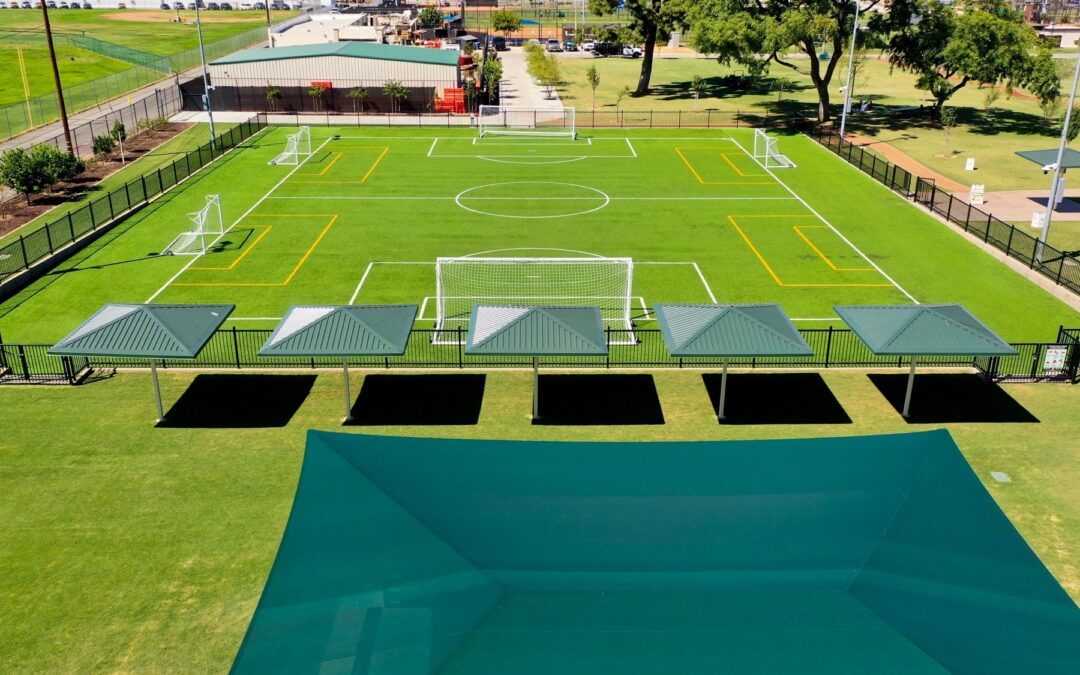
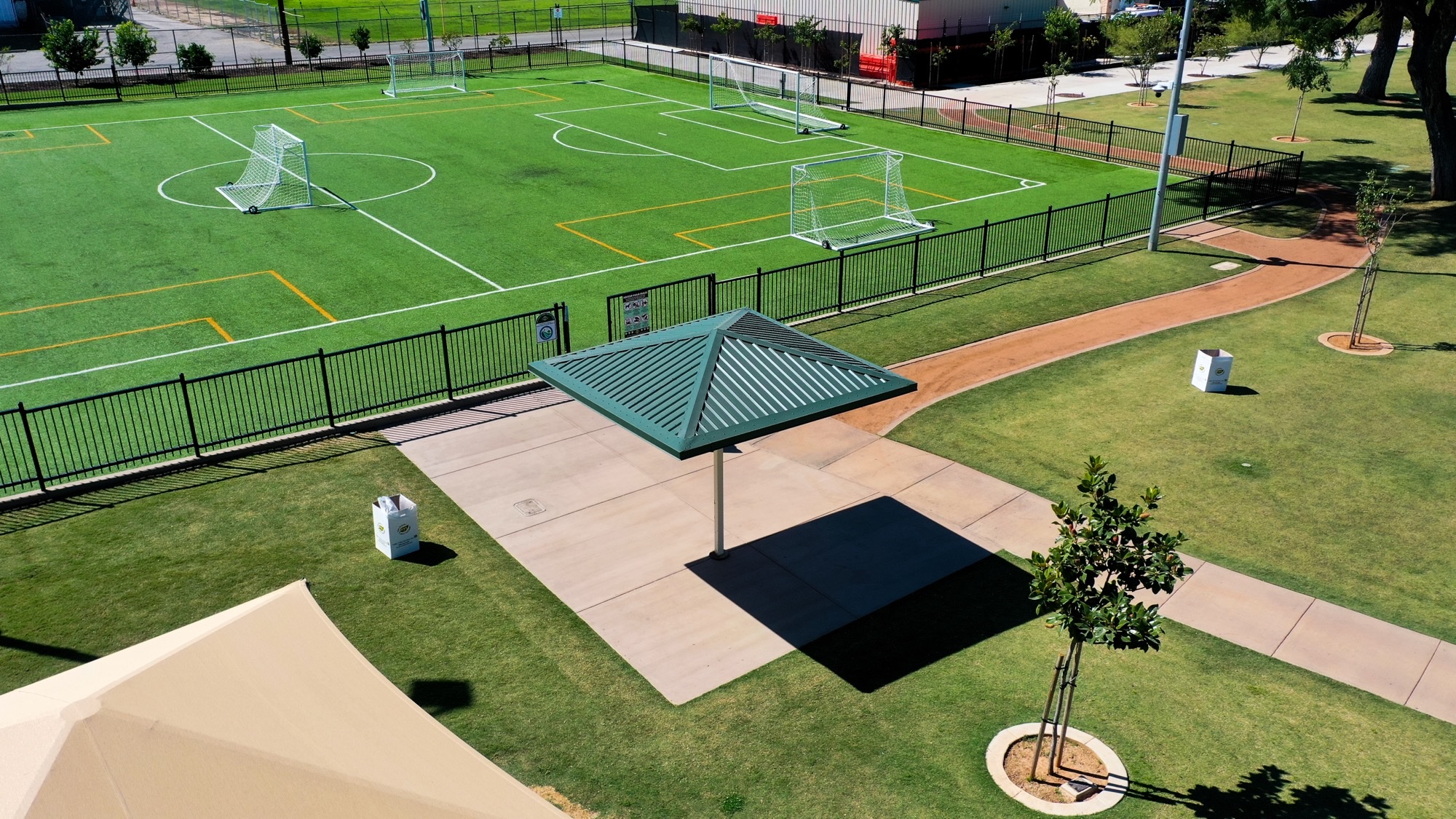
Players are not on the turf field surface for the entire length of a game or practice. They are on the sideline, on the bench, or in a bullpen area for a meaningful share of that time, and that is exactly where a cantilever canopy earns its keep. A cantilever structure can span the depth of a team bench or bullpen area without a single column breaking the sightline from the field, the press box, or the opposing bench, which is why cantilever designs dominate sideline shade specifications. Our cantilever canopies are engineered specifically for this kind of column-free coverage over benches, dugouts, and sideline seating.
Bench shade matters for a second reason beyond comfort: athletic trainers rely on a shaded bench area as a staging zone for hydration breaks, equipment, and heat-illness monitoring. A shaded bench gives the training staff a controlled environment to pull a player for a water break or a core-temperature check without walking them off the field entirely. For programs managing a heat-acclimatization protocol, that shaded bench zone functions almost like medical infrastructure, not just a comfort amenity.
Warm-up and bullpen areas along the sideline of a turf field deserve the same treatment, particularly for baseball and softball programs where pitchers and catchers warm up in direct sun for extended stretches before taking the field. A properly placed canopy over a bullpen keeps warm-up routines from becoming a heat-exposure risk before the player has even entered competition.
Spectator Shade: Bleachers, Grandstands, and Standing-Room Areas
Spectator areas around a turf field are the second priority tier, and the calculus is a little different. Parents, students, and community members sitting in bleachers for an hour or two of a varsity match are absorbing both ambient heat and the reflected radiant heat coming off that hot surface just a few yards away. Districts that have added shade over bleacher sections at turf stadiums consistently report it as one of the most visible, most appreciated capital improvements they have made, because unlike a lot of facility spending, spectators see and feel the difference immediately.
Bleacher and grandstand shade on a turf field needs to account for sightlines in a way that a playground or parking lot canopy does not. A cantilever structure anchored behind the top row of bleachers, projecting forward over the seating, keeps every column out of the sightline between any seat and the field. Our cantilever vs. four-post comparison walks through the clearance and sightline tradeoffs in more detail, and it is directly relevant to anyone speccing shade over stadium seating at a turf facility.
Standing-room areas, concourse zones, and concession lines around a turf stadium are a third zone worth shading, particularly at multi-field municipal complexes where families move between games over several hours. We cover concession-area shade design in more depth in our concession stand shade structures guide, which applies directly to turf field complexes with on-site food service.
Heat-Illness and Safety Considerations
Heat illness among athletes playing on synthetic turf fields is a documented and growing concern for athletic trainers, and shade placement is part of a broader heat-safety protocol rather than a standalone fix. OSHA’s heat-illness guidance for outdoor work environments, while written primarily for industrial and agricultural settings, outlines the same core principles that apply to athletic programs: provide shaded rest areas, monitor conditions through the day, and build in access to shade as part of a structured response plan rather than an afterthought. Review OSHA’s heat exposure guidance when your athletic department or facilities team is building or updating a heat-safety protocol for the field.
ADA access is the second compliance layer. Spectator shade structures over bleachers or standing-room areas need accessible routes and, where seating is provided under the canopy, accessible seating locations that are not segregated to the unshaded edge of the structure. Any stadium renovation that touches spectator areas is also a reasonable moment to audit accessible routes from parking to the field, since shade construction often overlaps with other site-accessibility upgrades.
Wind engineering deserves specific attention at these sites because they are often open and exposed, with few surrounding buildings or trees to break wind loads, which is a very different wind environment than a courtyard or parking lot. A canopy spec written for a sheltered site should not be copied directly onto an open turf field without the engineer re-checking exposure category and wind loads for the actual site conditions.
Materials and Specs for Turf Field Canopies
Fabric choice on a turf field canopy comes down largely to whether the structure needs to keep rain off players and equipment or simply block sun. HDPE knitted shade fabric blocks the large majority of UV radiation while allowing airflow through the weave, which keeps a bench or bullpen area from turning into a greenhouse on a still, hot day. Waterproof PVC membrane adds rain protection, useful over scorer’s tables, press boxes, or any equipment that cannot get wet, at the cost of reduced airflow underneath. Many complexes mix both: HDPE over open bench seating, PVC over equipment and electronics zones.
Steel frame and footing design on these projects has to coordinate closely with the turf installation itself. Footings for sideline and bench canopies typically sit outside the turf field’s finished edge, in the surrounding concrete or asphalt apron, which keeps excavation and footing work from disturbing the turf system’s drainage layer. Coordinating footing locations with the turf installer’s drainage plan before either contractor breaks ground avoids a costly conflict later. Powder-coated steel frames hold up well against both UV exposure and the fertilizer, cleaning chemicals, and foot traffic common around athletic facilities.
Clear height matters more here than it might on a parking canopy. Bench-area canopies need enough clearance for players standing with equipment, coaches on their feet during a timeout, and, at baseball and softball bullpens, a pitcher’s full windup. Twelve feet of clear height is a reasonable minimum for most sideline bench applications, with more clearance recommended wherever a canopy sits close to a backstop, dugout roof, or scoreboard structure that could create a pinch point.
Our In-House Process for Turf Field Shade Projects
Custom Canopies Inc. designs, engineers, fabricates, and powder coats every structure in-house, which matters on a turf field project because sideline and bleacher locations are rarely a simple catalog fit. Our process runs through six steps: consultation, where we walk the site and talk through sightlines, bench and bullpen locations, and existing turf edges; drafting, where our in-house engineers lay out column placement and clear heights custom to the inch for the specific field; manufacturing and powder coating at our own facility; and shipping and installation, with national service to any site in the US. Full details on our engineering and design workflow are in our commercial design process overview.
Because we hold Contractors License #880322 and Fabricators License #FB00073, districts and municipalities running a public bid process for a sideline shade package have a straightforward path to specify and award the work through standard procurement channels.
Facility-Type Breakdown
School districts with turf stadiums tend to prioritize bench shade and home-side bleacher shade first, often phasing visitor-side and concourse shade into a later capital cycle as budget allows. Multi-field municipal and county parks complexes, where several turf fields share a central concourse, often get more value from shading the shared concourse and concession zone that every family passes through across a tournament weekend than from shading any single field’s benches alone. Private club and travel-ball facilities, where these fields run tournaments across consecutive long days, frequently prioritize dugout and bullpen shade across every field on the site, since those are the areas with the heaviest sustained player exposure over a multi-day event.
Buying Mistakes to Avoid
The most common mistake is treating field shade as a single decision rather than a phased plan. Trying to budget full coverage of every bench, bullpen, and bleacher section in one capital cycle often prices a project out of range; phasing bench and bullpen shade first, with spectator shade in a later phase, is usually both more affordable and more directly tied to player safety. The second common mistake is speccing a canopy without checking sightlines from the press box, scoreboard, and opposing bench, which can mean an expensive structure that has to be relocated once someone notices it blocks a camera angle or an official’s view. The third is skipping a wind-exposure review specific to the actual field site, since these complexes are frequently built on open, unshielded ground where generic wind assumptions from a sheltered-site design do not hold.
Cost Drivers for Turf Field Shade Structures
Cost on a turf field shade project scales primarily with span, clear height, and fabric choice. A cantilever bench canopy with a modest span and HDPE fabric sits at the lower end of commercial shade pricing industry-wide; a waterproof PVC membrane structure over a wider bleacher section, with the steel and footing work that extra wind exposure requires, runs meaningfully higher. Site conditions around the field, existing concrete apron versus new footings cut into the surrounding grade, utility conflicts near scoreboards and sound systems, and any ADA path-of-travel work bundled into the same project, all move the number as well. Because every site is different, the most reliable way to budget a project is a site-specific quote rather than a generic per-square-foot estimate; contact our team for a quote scoped to your field.
Frequently Asked Questions
Can you shade an entire turf field?
Engineering a column-free canopy across a full regulation field is possible in theory but almost never practical. The steel tonnage, wind-uplift engineering, and footing requirements scale sharply with span, and most turf manufacturers’ warranties assume open-air drying conditions that a full canopy would disrupt. Sideline, bench, and spectator shade deliver most of the safety benefit at a fraction of the cost and complexity.
How much hotter is a turf field than grass?
Surface temperature studies have measured synthetic turf fields 30 to 50 degrees Fahrenheit hotter than ambient air temperature on sunny days, with peak summer readings well above 140 degrees. Natural grass under the same conditions typically stays within 10 to 15 degrees of air temperature.
Where should shade go first on a turf field project?
Team bench and bullpen areas are the highest-priority zones because players spend sustained time there in direct exposure to both ambient heat and radiant heat off the turf surface. Spectator bleachers and concession or concourse areas are typically the next phase.
What fabric is best for turf field canopies?
HDPE knitted shade fabric blocks the large majority of UV radiation while allowing airflow, making it a strong fit for open bench and bullpen areas. Waterproof PVC membrane adds rain protection for equipment, scorer’s tables, and press box zones at the cost of reduced airflow.
Does adding shade affect our turf warranty?
Properly engineered sideline and bench canopies, placed outside the turf field’s finished edge with footings coordinated against the drainage plan, generally do not conflict with turf warranties. A full-field canopy altering drying time and light exposure across the entire surface is the scenario that can create warranty questions, which is one more reason full coverage is rarely the right approach.
Do cantilever canopies work for sideline bench shade?
Yes. A cantilever design spans the depth of a bench or bullpen without a column interrupting sightlines from the field, press box, or opposing bench, which is why cantilever structures are the standard choice for sideline and dugout shade on turf fields.
How tall should a turf field bench canopy be?
Twelve feet of clear height is a reasonable minimum for most bench applications, with additional clearance recommended near backstops, dugout roofs, or scoreboard structures where equipment or player movement could create a pinch point.
Can shade structures be added to an existing turf field?
Yes. Retrofitting sideline and bleacher shade onto one of these fields is common, and it typically involves locating footings in the surrounding concrete apron rather than cutting into the turf system itself, which limits disruption to the existing playing surface.
Get a Site-Specific Quote for Your Turf Field
Custom Canopies Inc. designs, engineers, fabricates, and installs sideline, bench, bullpen, and spectator shade structures for turf fields nationwide, with custom sizing to the nearest inch and in-house engineering behind every structure. Call (562) 464-4646 to talk through your field’s layout, or visit our contact page to request a site-specific quote for your shade project.
Free Project Quote
What type of project is this?
Tell us where the shade structure is going and a specialist will design around your site.
Free Project Quote
Tell us about your project
A sentence or two is plenty. Size, location, and timeline help us quote faster.
Free Project Quote
Where should we send your quote?
A shade specialist will review your project and reach out within 1 business day.
Thanks! We’ll be in touch shortly.
A shade specialist will review your project and reach out within 1 business day. Prefer to talk now? Call (562) 464-4646.