Head Start Center Playground Shade Structures: A Planning Guide
Head Start center playground shade structures are no longer a nice-to-have line item tucked into a facilities wish list. For Head Start and Early Head Start grantees, shaded outdoor space touches licensing, heat-related illness risk, and the daily usability of the only outdoor classroom many centers have. A single stretch of 95-degree afternoons can shut down outdoor play entirely if there is no shade, which means fewer gross motor minutes, fewer sensory activities, and a harder time meeting the outdoor-time expectations built into Head Start programming. This guide walks facilities staff, directors, and procurement teams through what commercial-grade playground shade actually involves: the Program Performance Standards that govern outdoor space, the safety and compliance details that matter for infant and toddler areas, the materials worth specifying, and how funding for a project like this typically comes together.
Custom Canopies Inc. designs and fabricates commercial shade structures in-house, including the structures installed over Head Start and child care playgrounds nationwide, and this article reflects what actually shows up in those projects rather than generic advice.
Facilities staff coming to this for the first time are usually juggling three separate conversations at once: a licensing or self-assessment requirement pointing at the outdoor environment, a program director asking why outdoor time keeps getting cut short in summer, and a budget cycle that may or may not have a line item for capital shade work. Treating those as one project instead of three separate problems is what actually gets a playground shade structure installed before the next heat season rather than tabled for another year of planning.
What Head Start Playground Shade Structures Need to Do
A playground shade structure built for a Head Start center has to satisfy more constraints than a typical park canopy. It needs to clear play equipment and fall zones without crowding sightlines that staff rely on for supervision. It needs to hold up to daily use by a licensed child care program, which means years of UV exposure, irrigation overspray, and the occasional bump from a rolling cart or tricycle. And because many Head Start centers operate inside leased buildings, co-located schools, or shared community facilities, the structure often has to work within a tight footprint and a facilities budget that was not originally built around capital shade projects.
That combination is why generic residential-style canopies rarely hold up in this setting. Head Start playground shade structures need engineered steel framing, commercial-grade knitted shade fabric rated for the regional wind and UV load, and a layout that a facilities director can defend to a licensing reviewer or a funding agency without hesitation.
Shade Planning Across Different Head Start Facility Types
Not every Head Start center starts from the same site conditions, and the shade plan usually needs to match the facility type. Standalone center-based programs with their own fenced yard typically have the most design freedom: a hip, pyramid, or cantilever structure can be sized to cover most or all of the play area without working around a neighboring program’s schedule or shared parking. These are often the easiest projects to engineer cleanly because the site boundary and the play area boundary are the same thing.
Head Start programs co-located inside a public elementary school face a different set of constraints. The playground may be shared or adjacent to K-5 equipment, which means a Head Start-specific shade structure has to be positioned to serve the younger age group’s smaller, separately fenced area without encroaching on the elementary yard’s own fall zones, and installation often has to work around the district’s academic calendar rather than the Head Start center’s own calendar.
Programs run out of community action agencies, churches, or other shared-use buildings tend to have the tightest footprints and the most irregular yard shapes, since the outdoor space was rarely designed with a dedicated early childhood program in mind. These sites are where cantilever structures and shade sails earn their keep, since both can cover a play area without placing posts inside a cramped, oddly angled yard. Early Head Start home-based or family child care partnership sites sometimes need a smaller-scale structure entirely, sized for a single small group rather than a full classroom cohort. Identifying which of these categories a center falls into early in the process saves a redesign cycle later, since the structure family that works for a standalone center rarely works unmodified for a shared-site program.
Why Playground Shade Matters for Head Start and Early Head Start Programs
Head Start and Early Head Start serve infants, toddlers, and preschoolers, populations with a limited ability to regulate body temperature and a higher relative surface area to body mass than adults. That makes sun and heat exposure a more immediate concern for this age group than for a general park population. Unshaded play structures can reach surface temperatures hot enough to burn skin within seconds during peak summer hours, and unshaded asphalt or rubberized surfacing radiates heat back up at toddler height, where children spend most of their time.
Beyond the physical safety angle, shade is an access issue. A Head Start classroom that cannot use its outdoor space for four or five months of the year because of heat is effectively losing a curriculum resource. Directors managing enrollment, attendance, and program quality reviews have a direct interest in outdoor space that functions year-round, not just in spring and fall.
What the Head Start Program Performance Standards Say About Outdoor Space
The Head Start Program Performance Standards (45 CFR Part 1302) require grantees to provide indoor and outdoor space, equipment, materials, and furniture suited to the ages of the children served and sufficient to implement the program’s curriculum. Outdoor space is explicitly part of the facility requirements, and programs are expected to maintain a safe, healthy learning environment both indoors and out. The standards do not spell out a shade percentage or a specific structure type, which is actually useful: it leaves room for a center to specify playground shade structures sized to its real site conditions rather than a boilerplate minimum.
What the standards do drive is documentation. Facilities self-assessments, environment rating scale reviews, and state licensing inspections all look at whether the outdoor environment is safe and usable across the conditions a center actually experiences. In hot-climate states, reviewers increasingly treat shade over infant and toddler play areas as part of that safety picture, not an optional amenity. Grantees that can point to engineered shade structures with documented fall-zone clearance and wind ratings have an easier time through that review process than grantees relying on a shade sail that was never engineered for the site.
CPSC Fall Zones, ADA Access, and Safety Rules for Head Start Playground Shade
Three compliance layers come up on almost every Head Start playground shade project. The first is fall zone clearance. The CPSC Public Playground Safety Handbook sets out use-zone requirements around play equipment, typically six feet beyond the perimeter of stationary equipment, more for slides and swings based on height and travel distance. Shade structure posts, footings, and any guy wires need to sit outside those zones. On a tight Head Start site, this is usually the single biggest design constraint, and it is why a site visit and accurate dimensions matter more here than on an open park lawn.
The second layer is accessibility. Outdoor space serving a federally funded early childhood program needs an accessible route to and through the shaded play area, with clearances that accommodate strollers, adaptive equipment, and staff assisting children with mobility needs. Post placement and footing design should leave that route clear rather than treating accessibility as an afterthought once the canopy is already drawn.
The third is wind and structural engineering specific to the site’s exposure category and local building code, which determines footing depth, post gauge, and fabric tensioning. A playground shade structure that is undersized for local wind loads is a liability risk a Head Start grantee cannot absorb, given that these programs serve some of the youngest and most vulnerable children in any commercial facility type.
Fabric, Posts, and Structure Types for Infant and Toddler Shade Areas
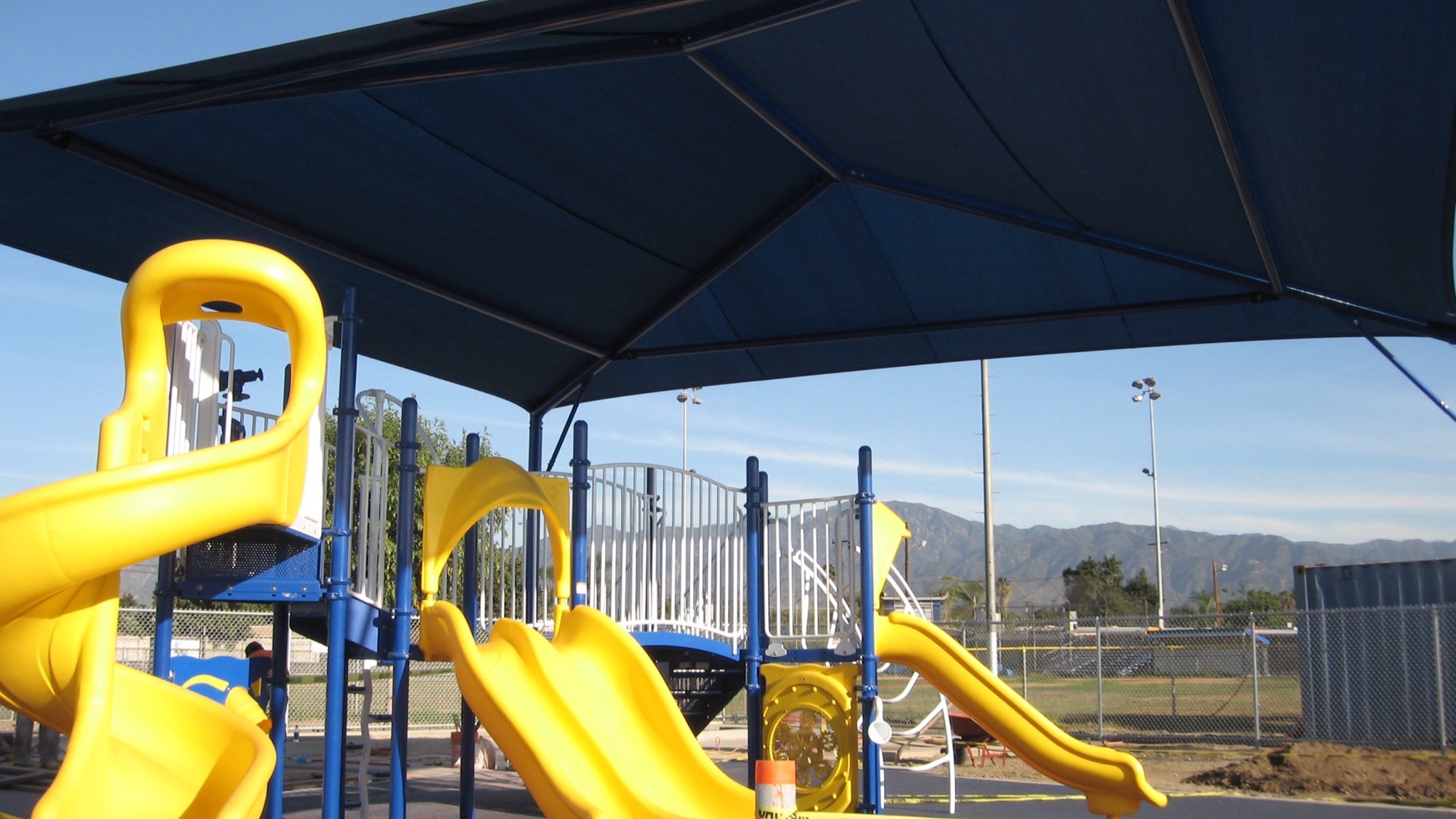
Most Head Start centers end up choosing between a few structure families: hip or pyramid canopies for compact infant and toddler yards, cantilever structures where posts cannot sit inside the play area at all, and shade sail systems for irregular footprints between buildings. Each has tradeoffs worth specifying up front rather than discovering mid-installation.
Knitted HDPE shade fabric is the standard choice for playground canopies because it blocks a high percentage of UV radiation while still allowing airflow, which keeps the space from trapping heat the way a solid roof can. Fabric should be specified with a documented UV block rating and a color chosen with some intention: darker colors cut more glare but run hotter to the touch, while lighter colors stay cooler for hands and read more clearly against a play structure’s own color scheme. Posts should be powder-coated steel rather than aluminum for a facility expecting decades of daily use, with footings sized to the engineered wind rating rather than a standard catalog minimum.
For infant areas specifically, directors often want shade low enough to meaningfully cool the ground and equipment but high enough to stay out of reach and clear of any climbing surface, a detail worth flagging during design rather than assuming a standard clearance height will work for a crawling or cruising age group.
Surfacing underneath the shade deserves its own line in the spec sheet. Engineered wood fiber, poured-in-place rubber, and rubber tile all perform differently once shaded, since a shaded surface retains moisture longer than an unshaded one and some fall-protection surfacing requires different drainage or maintenance once it is no longer drying out in direct sun all day. Coordinating the shade structure’s footprint with whoever maintains the surfacing, whether that is the Head Start grantee’s own maintenance staff or a shared facilities department, avoids a situation where the canopy solves the heat problem but creates a drainage or maintenance problem underneath it.
How Custom Canopies Builds Head Start Center Playground Shade Structures
Custom Canopies runs every project, including Head Start and child care playground work, through the same six-step process: consultation, drafting, manufacturing, coating, shipping, and installation. For a Head Start center, the consultation stage is where fall zones, accessible routes, and existing play equipment dimensions get measured on-site rather than estimated from a satellite photo. Drafting produces structure drawings sized to the nearest inch for the actual yard, not a standard off-the-shelf footprint, which matters on the tight, oddly shaped sites common to leased and co-located Head Start facilities.
Manufacturing and powder coating happen in-house, which keeps lead times predictable for grantees working against a grant spending deadline or a licensing renewal date. Shipping and installation are handled nationally, so a Head Start grantee in any state works with the same engineering and fabrication standards rather than a regional subcontractor network of varying quality. Because Custom Canopies holds both a contractor’s license and a fabricator’s license, documentation for grant files and licensing reviews comes from a single accountable source rather than being split across a designer, a fabricator, and an installer.
Funding Head Start Playground Shade Structures Through Facilities and Grants
Shade projects for Head Start centers typically get funded through one of three paths: the program’s annual facilities and equipment line, a one-time Head Start facilities grant or Early Head Start-Child Care Partnership funding cycle, or, for grantees operating inside a school district or community action agency, a shared capital improvement budget. Because playground shade is a safety and licensing-adjacent investment rather than a discretionary amenity, it typically competes well for facilities dollars once a director can show engineered drawings, a site plan, and a firm quote rather than a rough estimate.
Timing matters more than most grantees expect. Grant cycles and fiscal year-end facilities spending often have hard deadlines, and commercial shade structures involve engineering review, fabrication, and, in many states, a permit before installation can start. Getting a quote and a drafted structure early in a budget cycle, rather than after funds are already allocated, gives a center room to actually spend the money it has been awarded instead of losing it to a deadline.
Buying Mistakes Head Start Grantees Make With Playground Shade
The most common mistake is measuring the yard from a site plan instead of a physical site visit, which leads to posts landing inside fall zones or blocking an accessible route once the structure actually arrives. The second is choosing a structure sized for the current enrollment rather than licensed capacity, which leaves a center needing a second shade project within a few years as play areas expand. The third is skipping engineered drawings in favor of a lower-cost, non-engineered canopy; this typically backfires at licensing review or, worse, during a wind event the structure was never rated to survive.
A less obvious mistake is treating color and fabric choice as purely aesthetic. Fabric color affects both surface temperature underneath the canopy and how visible the shaded area is from a supervision standpoint, both of which matter more on a Head Start playground than on a general park structure. Centers that loop their facilities staff, their licensing specialist, and their shade manufacturer into the same conversation early tend to avoid most of these issues; centers that treat the canopy as a late-stage purchase order usually do not.
A final, frequently expensive mistake is ignoring the center’s growth plan. A Head Start grantee that expects to add an Early Head Start classroom, convert a storage building into additional licensed space, or expand enrollment within the next few years should size the shade structure’s footings and framing with that expansion in mind, even if only one phase gets built now. Retrofitting a second structure next to a first one later is possible, but it rarely matches the original as cleanly, in both appearance and engineering, as a structure planned as one connected system from the start.
FAQ: Head Start Center Playground Shade Structures
Do the Head Start Program Performance Standards require shade structures over playgrounds?
The standards require outdoor space suited to the ages of children served and sufficient for safe, year-round program use, but they do not specify a shade percentage or structure type. In practice, hot-climate grantees increasingly treat engineered shade as part of meeting that safety standard, especially for infant and toddler areas.
How far do shade structure posts need to stay from play equipment?
Posts and footings need to sit outside the CPSC use zone for the adjacent equipment, generally a minimum of six feet from stationary equipment and more for slides and swings depending on height and travel path. A site-specific drafting process catches these clearances before fabrication rather than after.
What fabric works best for infant and toddler shade areas?
Knitted HDPE shade fabric with a documented UV block rating is standard because it blocks the majority of UV radiation while allowing airflow underneath. Lighter colors run cooler to the touch, which is worth weighing for areas where children and caregivers are at ground level.
Can a shade structure be installed without disrupting a Head Start program in session?
Yes, with phasing. Fabrication happens off-site, so on-site work is largely limited to footing excavation, post setting, and fabric installation, which can often be scheduled around naptime, weekends, or short closures depending on the center’s calendar.
How do Head Start grantees typically pay for a playground shade structure?
Common funding sources include the annual facilities and equipment budget line, one-time Head Start facilities or Early Head Start-Child Care Partnership grant funding, or a shared capital budget for grantees co-located with a school district or community action agency.
What structure type works best for a small or irregularly shaped Head Start yard?
Hip and pyramid canopies suit compact, rectangular yards well, while shade sail systems handle irregular footprints between buildings or fences more efficiently. A site visit is the fastest way to confirm which layout actually fits without crowding fall zones or accessible routes.
How long does a Head Start playground shade structure take from quote to installation?
Timelines vary by structure size, engineering review, and local permitting, but grantees working against a grant spending deadline should start the consultation and drafting process as early in the budget cycle as possible to leave room for fabrication and installation.
Get a Quote for Your Head Start Center Playground Shade Structure
Head Start center playground shade structures work best when fall zones, accessible routes, and fabric choices are all planned together instead of bolted on after the fact. Custom Canopies Inc. handles consultation, engineered drafting, in-house manufacturing, powder coating, shipping, and installation for Head Start and Early Head Start centers nationwide, with sizing custom to the nearest inch for your actual site. For more on how commercial sites get designed and specified, see commercial shade structure design, and for a closer look at upgrading an existing play area, see the playground shade structure retrofit guide. Call (562) 464-4646 or visit the contact page to start a site consultation and get a firm quote for your center.
Free Project Quote
What type of project is this?
Tell us where the shade structure is going and a specialist will design around your site.
Free Project Quote
Tell us about your project
A sentence or two is plenty. Size, location, and timeline help us quote faster.
Free Project Quote
Where should we send your quote?
A shade specialist will review your project and reach out within 1 business day.
Thanks! We’ll be in touch shortly.
A shade specialist will review your project and reach out within 1 business day. Prefer to talk now? Call (562) 464-4646.