Dealership Service Drive Canopies: A Commercial Buyer’s Guide
A service drive is one of the hardest-working areas on a dealership lot. Advisors write up repair orders in direct sun, technicians move between bays and open-air staging lanes, and customer vehicles sit exposed to UV and weather for hours at a time. Dealership service drive canopies solve a specific commercial problem: they keep the write-up lane, staging area, and customer drop-off zone covered year-round without slowing down vehicle flow. For facilities managers, fixed operations directors, and dealer principals planning a service drive renovation, the canopy is not a cosmetic add-on. It is functional infrastructure that protects people, paint, and process.
This guide walks through what a dealership service drive canopy actually needs to do, how clear heights and lane widths get sized for lifted trucks and vans, the tradeoffs between waterproof PVC membrane and HDPE mesh, how lighting and signage integrate into the structure, and the buying mistakes that show up again and again on dealership projects. It is written for commercial buyers, not homeowners, because a service drive canopy is a fleet-grade structure that has to perform every single day the store is open.
What Are Dealership Service Drive Canopies?
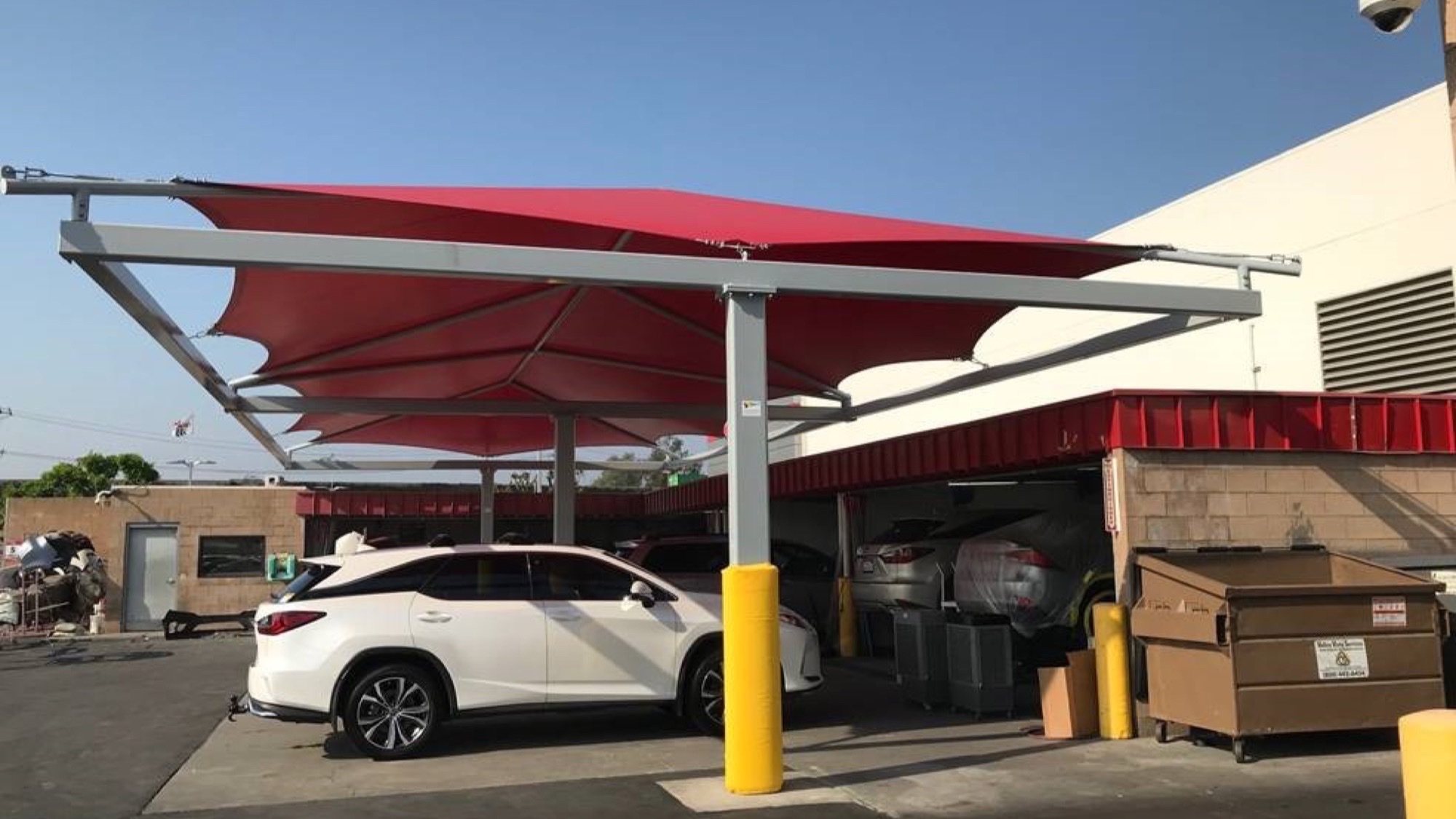
A dealership service drive canopy is a permanent, engineered shade structure built over the write-up lane, vehicle staging area, or customer drop-off zone at a dealership’s service department. Unlike a retail awning or a decorative carport, a service drive canopy is sized around vehicle movement: advisors walking a lane with a tablet, technicians pulling vehicles in and out of bays, and customers dropping off keys without stepping into weather. Most dealership service drive canopies use a steel post-and-beam frame, either cantilevered off one side of the lane or supported on a T-bar or four-post layout, with a tensioned fabric or waterproof membrane roof stretched across the top.
The design brief for a service drive canopy differs from a standard parking canopy in three ways: clear height has to accommodate lifted trucks and tall vans, the footprint has to leave sightlines open for advisors and cameras, and the structure often needs to integrate lighting and dealership branding. A well-designed service drive canopy reads as part of the building, not an aftermarket tent.
Why Service Drive Shade Is a Commercial Priority
Dealership fixed operations teams are measured on throughput, customer satisfaction scores, and technician retention, and a shaded service drive touches all three. Advisors who write up vehicles in full sun for eight hours a day burn out faster, and turnover in fixed ops is expensive to backfill and train. A service drive canopy keeps the write-up lane comfortable enough that staff can move efficiently between vehicles instead of retreating indoors between customers.
Vehicle protection is the second driver. Customer cars sitting in direct sun for a multi-hour repair or an all-day diagnostic appointment take real UV exposure: interior trim fades, dashboards crack, and paint clear coat degrades faster under prolonged heat. A dealership service drive canopy protects the store’s liability exposure on vehicles it does not own, which matters more at high-line and luxury stores where customers notice interior fading immediately.
Third, a covered service drive is a customer-facing signal. Buyers judge a dealership’s professionalism the moment they pull in, and a clean, shaded, well-lit drop-off lane reads as a store that invests in its operation. Many dealer groups now specify service drive canopies as a standard part of facility image programs, alongside signage packages and building refreshes referenced in a commercial shade design plan.
Clear Height and Lane Width Planning for Lifted Trucks and Vans
The single most common design failure on a service drive canopy is clear height that works for sedans but not for the trucks, vans, and SUVs that actually roll through the lane. Commercial buyers should plan clear height around the tallest vehicle the service drive regularly handles, not the average.
- Standard passenger vehicles need roughly 8 to 9 feet of clear height.
- Full-size pickups and cargo vans with roof racks or ladder racks typically need 11 to 12 feet.
- Lifted trucks, work trucks with utility bodies, and RVs coming through for service can require 13 feet or more.
- Fire lane and emergency vehicle access clearances, where applicable, should be confirmed with local code before finalizing post placement.
Lane width matters just as much as height. A single write-up lane generally needs 12 to 14 feet of clear width to let a service advisor walk the vehicle while another car queues behind it. Multi-lane service drives at higher-volume stores often run 24 to 40 feet of total covered width across two or three lanes, with posts set back far enough that mirrors and open doors clear the columns. Because Custom Canopies builds to custom sizing to the nearest inch rather than a fixed catalog size, dealership clear heights and lane widths get engineered around the store’s actual vehicle mix instead of a generic template.
Waterproof PVC Membrane vs. HDPE Mesh for Service Drive Canopies
Roof material is the biggest functional decision on a dealership service drive canopy, because it determines whether the lane stays dry, not just shaded, during rain.
Waterproof PVC membrane is a solid, coated fabric that sheds water completely, which makes it the standard choice for service drives, write-up lanes, and any area where advisors and customers need to stay dry during a downpour, not just out of direct sun. PVC membrane also blocks nearly all UV transmission, which is an advantage when protecting vehicle interiors and paint is part of the goal.
HDPE shade mesh is a knitted, breathable fabric that blocks 90 percent or more of UV rays but allows some air and light through, and it is not waterproof. HDPE works well over open parking fields and general vehicle staging where airflow and cost matter more than staying fully dry, but it is a poor fit for an active write-up lane where a rainy day would otherwise shut down curbside service.
Most dealership service drive canopy projects specify waterproof PVC membrane over the write-up lane and drop-off zone, sometimes paired with HDPE mesh over adjacent vehicle staging where full rain protection is less critical. For a deeper technical comparison of coatings, warranty life, and structural load differences between the two materials, see this waterproof shade structures guide.
Steel Framing, Powder Coating, and Lighting Integration
Dealership service drive canopies are engineered structures, not tents, and the frame material reflects that. Custom Canopies fabricates service drive canopy frames from steel, engineered and drafted in-house before manufacturing, so post spacing, beam depth, and footing design are calculated around each site’s actual wind and load conditions rather than pulled from a generic chart.
Powder coating matters more at a dealership than almost any other commercial site type, because the canopy usually sits within sightline of the showroom and has to match or complement brand colors. In-house powder coating lets a service drive canopy frame be finished in a manufacturer’s brand palette, from Toyota red to a neutral architectural gray, with a durable finish built to hold up to daily exposure rather than fade within a year or two.
Cantilevered frames are common on service drives specifically because they keep support columns out of the drive lane entirely, which matters when technicians are backing vehicles in and out repeatedly. A four-post or T-bar layout can work where the footprint allows wider column setbacks. Either approach should go through the same drafting and engineering review before fabrication begins.
A service drive canopy is one of the few shade structures where electrical and signage integration is expected, not optional. Advisors need to read repair orders and inspect vehicles after dark or on overcast days, so lighting design should be part of the canopy conversation from the start, not an afterthought bolted on after installation.
Common integration points on a dealership service drive canopy include:
- LED downlights or linear fixtures mounted to the underside of the beam structure for even write-up lighting.
- Conduit routed through or along steel columns during fabrication, rather than surface-mounted after the fact.
- Header signage or fascia panels for department branding, lane numbers, or manufacturer identification.
- Security camera mounting points, since service drives are a common target for vehicle theft and drive-off incidents.
Because Custom Canopies drafts each structure before manufacturing, electrical conduit paths and signage mounting points can be planned into the steel frame itself, which produces a cleaner finished look than retrofitting fixtures onto a structure that was not designed to carry them.
Compliance, Safety, and Wind Engineering
A service drive canopy has to hold up to more than sun exposure. Wind load engineering is the most important structural consideration, since a canopy over an active vehicle lane that fails in a storm creates a direct liability and safety hazard, not just a maintenance headache. Structures should be engineered to the wind speed and exposure category required by local building code, with stamped drawings available for permit review where the jurisdiction requires them.
Technician and advisor safety is the other compliance angle worth planning for. Staff working an uncovered service drive through a full shift face real heat exposure risk, and shade is one of the concrete engineering controls recommended in outdoor heat safety guidance from the Occupational Safety and Health Administration. A properly engineered canopy is not a substitute for a full heat illness prevention plan, but it is a meaningful physical control that reduces direct sun exposure for staff stationed at the write-up lane for hours at a time.
Fire lane clearance, ADA-accessible path of travel from parking to the service entrance, and local sign and structure permitting should all be confirmed with the store’s civil or architectural consultant before a canopy design is finalized, since requirements vary by jurisdiction.
Custom Canopies’ In-House 6-Step Approach
Custom Canopies runs every dealership service drive canopy project through the same six-step process used across its commercial work: Consultation, Drafting, Manufacturing, Coating, Shipping, and Installation. That in-house control matters specifically on service drive projects because so much of the design, lane clearance, electrical routing, and brand-color powder coating, depends on getting engineering and fabrication under one roof instead of coordinating separate vendors.
The consultation phase is where clear height requirements, lane counts, and lighting or signage needs get documented against the store’s actual vehicle mix. Drafting produces engineered drawings sized to the nearest inch rather than a stock template, which is what allows a service drive canopy to fit tightly against an existing building line or match up with adjacent parking canopies covered in this commercial parking lot shade structures guide. Manufacturing and powder coating happen in-house, and the finished structure ships and installs anywhere in the US, which matters for multi-rooftop dealer groups standardizing service drive design across locations.
Service Drive Canopies Across Dealership and Fleet Facility Types
Not every service drive looks the same, and the canopy design should reflect the facility type it covers. Franchise auto dealerships, RV and marine dealers, tire and quick-lube chains, and commercial fleet maintenance yards all run service drives with different vehicle profiles, throughput, and brand requirements.
Franchise auto dealerships typically need the most polish, since the service drive canopy sits within view of the showroom and factors into manufacturer facility image standards. Expect brand-specific powder coating, integrated signage, and clear height planned around the dealer’s actual inventory mix, from compact sedans to full-size trucks and SUVs.
RV and marine dealerships have the tallest clearance requirements of any facility type, since motorhomes, travel trailers, and boats on trailers can require 14 feet of clear height or more. A service drive canopy for an RV dealer generally needs wider lane spacing as well, since these vehicles take longer turning radii to maneuver into position.
Tire, quick-lube, and independent repair chains often run higher vehicle throughput per bay than a franchise dealership, which puts a premium on lane width and canopy footprint that keeps multiple cars staged without congestion. These facilities frequently prioritize waterproof PVC membrane over the customer waiting and drop-off zone specifically, since walk-in customers are less tolerant of getting wet than a dealership customer with a scheduled appointment.
Fleet maintenance yards, whether for municipal vehicles, delivery fleets, or utility trucks, tend to prioritize durability and clear height over branding. These service drives regularly need 13 feet or more of clearance for box trucks and utility bodies, and steel framing gets specified with an eye toward decades of daily use rather than a five-year facility refresh cycle.
Across all four facility types, the underlying engineering questions are the same: what is the tallest vehicle that regularly uses the lane, how much covered width does throughput require, and does the roof material need to be fully waterproof. Getting those three answers right during consultation is what separates a service drive canopy that works for the next twenty years from one that gets outgrown within five.
Common Buying Mistakes with Dealership Canopy Projects
A handful of mistakes show up repeatedly on dealership service drive canopy projects, and most of them are avoidable with better upfront planning.
- Sizing clear height for sedans instead of the tallest regular vehicle. A canopy that clears a Camry but not a lifted F-250 forces trucks to queue outside coverage.
- Choosing HDPE mesh over an active write-up lane. Mesh looks similar to membrane in a rendering, but it will not keep advisors or customers dry during rain.
- Skipping wind engineering to save on upfront cost. A structure that is not engineered for local wind exposure is a liability risk over a lane full of customer vehicles.
- Treating lighting and signage as a post-installation add-on. Retrofitting conduit and fixtures onto finished steel costs more and looks worse than planning it into the frame.
- Underestimating column setback for door swing and mirror clearance. Posts placed too close to the drive lane get hit by open doors and side mirrors within the first year.
- Not matching powder coating to brand standards. A mismatched frame color undercuts an otherwise clean facility image right at the customer’s first impression of the store.
Most of these mistakes trace back to skipping a proper consultation and drafting phase in favor of a fast, generic quote. Questions on any of these points, along with sizing, materials, or timeline, are covered in more depth on the shade structure FAQ page.
Every service drive canopy is priced around the specific site, so exact numbers vary, but several factors consistently move the budget on commercial projects of this type. Total covered square footage and lane count are the biggest driver, since a single write-up lane costs far less than a multi-lane covered drive spanning 40 feet or more. Roof material is the next factor: waterproof PVC membrane generally costs more per square foot than HDPE mesh, reflecting its full rain protection and UV blocking. Clear height and engineered wind load requirements also affect steel tonnage, since taller structures built to withstand higher wind speeds need heavier columns and deeper footings. Finally, electrical integration, lighting, signage mounts, and custom powder coating in brand-specific colors add scope beyond a bare-bones shade structure. Because pricing depends so heavily on site conditions, vehicle mix, and local code, the most accurate way to budget a project is a site-specific consultation rather than a general estimate.
Frequently Asked Questions
How tall does a dealership service drive canopy need to be?
Clear height should be sized to the tallest vehicle regularly serviced, not the average. Most service drives need at least 11 to 12 feet for trucks and vans, with 13 feet or more where lifted trucks and RVs are common.
Should a service drive canopy use waterproof PVC membrane or HDPE mesh?
Waterproof PVC membrane is the standard choice for active write-up lanes and drop-off zones because it keeps advisors and customers fully dry during rain. HDPE mesh is better suited to open staging areas where airflow matters more than full rain protection.
Can a dealership service drive canopy be powder coated to match brand colors?
Yes. Custom Canopies powder coats every frame in-house, which allows dealership service drive canopies to be finished in manufacturer brand colors or a store’s chosen architectural palette.
How long does a dealership canopy project take from consultation to installation?
Timelines vary by structure size, engineering complexity, and local permitting, since drafting and stamped drawings, where required, add review time before manufacturing begins. A site-specific consultation is the fastest way to get an accurate project timeline.
Do service drive canopies need engineered wind load design?
Yes. A canopy positioned over an active vehicle lane needs to be engineered to local wind speed and exposure requirements, since structural failure over occupied vehicles and staff is a direct safety hazard.
Can lighting and security cameras be built into a service drive canopy?
Yes. Conduit routing, LED fixture mounts, and camera mounting points can be engineered into the steel frame during drafting, which produces a cleaner result than retrofitting fixtures after installation.
Can one canopy cover multiple service drive lanes?
Yes. Multi-lane service drives commonly run 24 to 40 feet of continuous covered width across two or three lanes, engineered as a single structure with column placement set back from vehicle paths.
Get a Site-Specific Quote for Your Service Drive
Dealership service drive canopies are a working part of a fixed operations department, not a decorative addition, and getting clear height, roof material, and lighting integration right the first time keeps a service drive productive for decades. Custom Canopies handles consultation, drafting, in-house manufacturing, powder coating, shipping, and installation for dealership canopy projects nationwide, with custom sizing engineered to each store’s actual vehicle mix and site conditions.
Call (562) 464-4646 or visit the contact page to start a site-specific consultation for a dealership service drive canopy.
Free Project Quote
What type of project is this?
Tell us where the shade structure is going and a specialist will design around your site.
Free Project Quote
Tell us about your project
A sentence or two is plenty. Size, location, and timeline help us quote faster.
Free Project Quote
Where should we send your quote?
A shade specialist will review your project and reach out within 1 business day.
Thanks! We’ll be in touch shortly.
A shade specialist will review your project and reach out within 1 business day. Prefer to talk now? Call (562) 464-4646.