Shade Sails for School Campuses: A Commercial Buyer’s Guide
Shade sails for school campuses have moved well past the playground fence. Facilities managers, procurement teams, and district architects are now specifying shade sails for lunch areas, walkways, bus loading zones, and outdoor classrooms, anywhere students and staff spend time in direct sun for more than a few minutes at a stretch. The reason is simple: unshaded concrete and asphalt on a campus can reach surface temperatures 40 to 60 degrees hotter than the surrounding air, and that heat load affects attendance, behavior, and staff comfort just as much as it affects a child on a slide. If your district or private campus is evaluating shade sails for school campuses this year, this guide walks through what the structures are, where they belong beyond the play yard, the compliance and wind engineering questions a reviewing agency will ask, the materials that hold up to years of daily use, and the buying mistakes that turn a good shade sail project into a change-order headache.
This is not a decision that only affects student comfort on a handful of hot afternoons. Districts are increasingly building shade sails for school campuses into capital improvement plans and bond measures alongside HVAC upgrades and roofing, because the same heat mitigation logic applies outdoors as indoors: staff and students perform better, and stay outside longer, when the environment doesn’t work against them. A well-planned shade sail rollout also protects a district’s investment in outdoor furniture, turf, and playground equipment, since UV exposure degrades those surfaces faster than shaded ones. Treating campus shade sails as infrastructure, not landscaping, changes how a project gets scoped, budgeted, and reviewed from the very first site visit.
What Are Shade Sails for School Campuses?
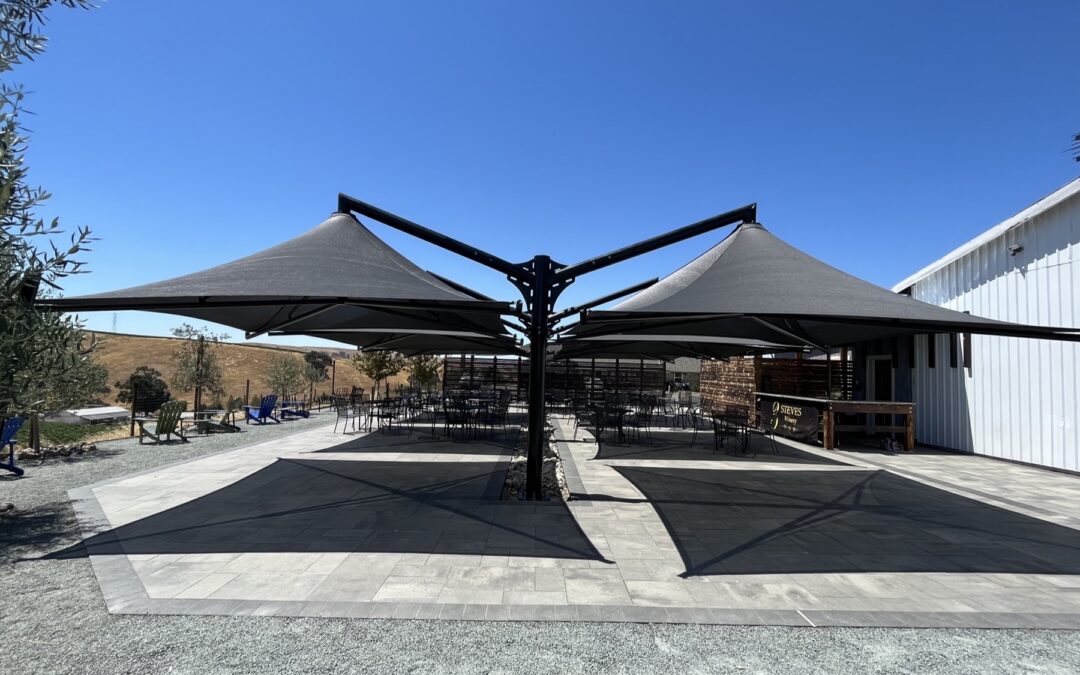
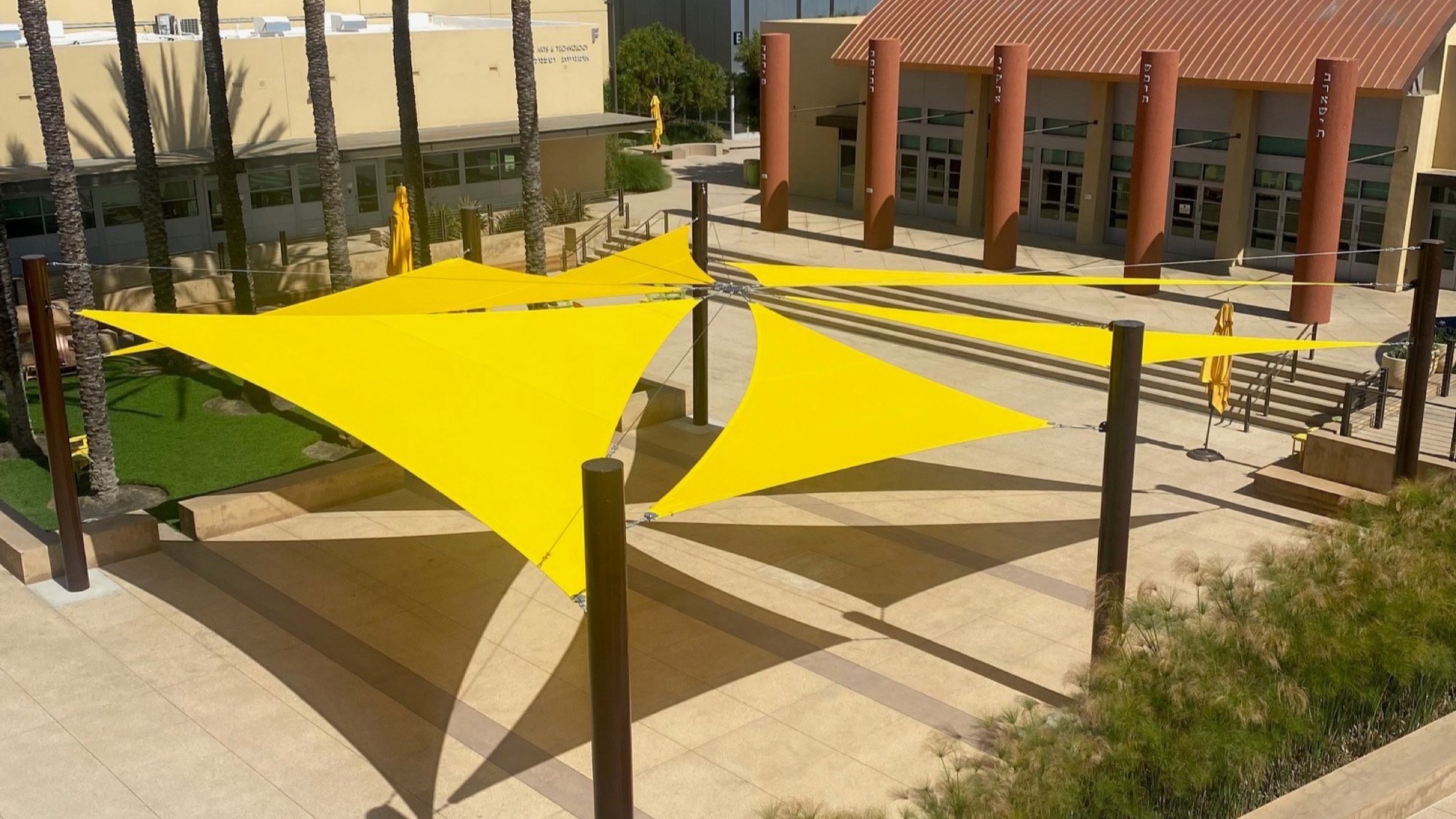
A shade sail is a tensioned fabric membrane, usually a triangle, rectangle, or hyperbolic (hypar) shape, stretched between steel posts or anchored to an adjacent building. Unlike a fixed metal canopy with a rigid roof, a shade sail relies on tension and curvature for its structural stability, which lets it span open plazas, courtyards, and walkways with fewer support posts than a conventional canopy. On a school campus, that translates into wide-open lunch tables and outdoor classroom zones without a forest of columns breaking up sightlines or blocking supervision.
Shade sails for school campuses are typically fabricated from knitted high-density polyethylene (HDPE) shade cloth, which blocks 90 to 97 percent of UV radiation while still allowing airflow through the weave. That airflow matters on a campus: a solid roof over a courtyard traps heat underneath it on a still day, while a well-engineered shade sail keeps air moving and can measurably lower the perceived temperature under the structure compared to open sun.
The sail count and arrangement also shape how a space actually gets used. A single large sail over a lunch quad creates one uniform shaded zone, while a cluster of smaller, overlapping sails at varying heights can shade an irregular walkway or a garden classroom without forcing the design into a single rectangle. Because shade sails for school campuses are engineered per site rather than sold off a shelf, the geometry can follow the way students actually move through a space instead of the other way around.
Why Campuses Need Shade Sails Beyond the Playground
Most districts start their shade conversation at the play structure, and rightly so, but a full campus shade plan looks at every zone where students congregate outdoors. Lunch areas are the most common second phase: a covered quad keeps cafeteria overflow seating usable on 95-degree days instead of pushing every student back indoors during a lunch period that is already too short. Walkways between buildings are another priority, particularly at elementary campuses where younger students move between classrooms, the cafeteria, and restrooms multiple times a day without the benefit of covered corridors.
Outdoor classrooms are the fastest-growing use case for shade sails on school campuses. Districts investing in garden classrooms, STEM labs, and flexible outdoor learning pods need shade sails that can span irregular footprints, since these spaces are rarely a clean rectangle. Bus loading and pickup zones are the fourth major zone: staff supervising dismissal stand in the same unshaded spot every school day, and a shade sail over a loading zone is one of the more overlooked ways a district can address staff heat exposure. When you’re planning shade sails for school campuses, mapping all four zones, play areas, lunch areas, walkways, and outdoor classrooms, before you engineer a single structure keeps the project from feeling piecemeal three years later.
Compliance, Safety, and Wind Engineering for School Shade Structures
Public school construction in California runs through the Division of the State Architect (DSA), and any shade sail attached to or located on a public school campus, including play area and non-play area structures, is typically subject to DSA review. That review checks structural calculations for wind and seismic loads, anchorage details, and accessibility clearances, not just for the shade sail itself but for how it interacts with adjacent paths of travel. A shade sail manufacturer with in-house engineering can produce DSA-ready calculations and submittals as part of the original scope, which is worth confirming before you sign a contract. Our DSA-approved canopies page covers what that review process typically involves for California public schools.
Wind engineering deserves its own line item in any RFP for shade sails for school campuses. A tensioned fabric structure behaves very differently in wind than a rigid roof: the membrane itself, the cable tensioning, the post foundations, and the anchor hardware all have to be sized for local wind speed exposure category and the specific geometry of the sail. Under-engineered shade sails are one of the most common failure points on campuses, usually showing up as fabric tearing at a corner attachment point or a post foundation that was sized for a smaller structure than what ended up installed. Accessibility is the other compliance thread: shade structures over walkways and gathering areas need to preserve required clearances and accessible routes. The U.S. Access Board and ADA.gov are useful references for accessible route requirements when a shade sail spans or borders a path of travel.
Materials and Specs That Hold Up on a Campus
School campus shade sails see more daily wear than almost any other commercial shade application. Hundreds of students pass under and around the structure every day, custodial crews power-wash the surrounding concrete, and the fabric itself is exposed to full sun for the entire school year. The knitted HDPE shade cloth used in most commercial shade sails carries a UV block rating in the 90 to 97 percent range and is treated to resist mold and mildew, but the fabric grade, denier, and knit density vary widely between suppliers, so it’s worth asking a manufacturer for the specific fabric spec sheet rather than a generic “shade cloth” line item.
Support posts on campus shade sails are almost always steel, powder coated to resist the corrosion that comes from years of sprinkler overspray, cleaning chemicals, and coastal air in many California districts. Cable tensioning hardware, turnbuckles, and corner plates should be stainless steel or hot-dip galvanized, since these are the components most likely to corrode and fail quietly if a cheaper hardware package is substituted during value engineering. Post footings need to be sized to the engineered wind load for that specific site, not a standard footing detail borrowed from a smaller project. When you’re comparing bids for shade sails for school campuses, ask each vendor for their fabric warranty length, hardware material, and whether foundations are engineered per site or standardized across projects.
Custom Canopies’ In-House Approach to Campus Shade Sails
Custom Canopies Inc. is a family-owned, made-in-America manufacturer that keeps engineering, fabrication, and powder coating in-house rather than subcontracting those steps out, which shortens the feedback loop between a district’s site constraints and the final structural drawings. Our process runs in six stages: Consultation, Drafting, Manufacturing, Coating, Shipping, and Installation. During consultation we walk the specific zones on your campus, whether that’s a lunch quad, a walkway corridor, or an outdoor classroom pad, and during drafting we size the sail geometry, posts, and anchors to the nearest inch for that site’s footprint and wind exposure.
Because fabrication and powder coating happen in the same operation, custom sizing doesn’t mean a longer supply chain or a third-party coating vendor introducing delays. Custom Canopies holds Contractors License #880322 and Fabricators License #FB00073, and we ship and install shade sails for school campuses nationally, not just within a single region. If your district’s shade plan spans multiple school sites, that in-house consistency matters: the same engineering standards, the same fabric specs, and the same hardware package follow the project from the first campus to the last.
Facility-Type Breakdown: Elementary, Secondary, and Higher Education Campuses
Elementary campuses tend to prioritize shade sails over play structures first, then extend coverage to walkways between classroom pods and the cafeteria, since younger students move between these spaces the most times per day. Sail heights and post placement need to account for supervision sightlines, since teachers and aides monitoring recess or lunch need clear views under and around the structure rather than a low sail edge blocking a sightline across the yard.
Middle and high school campuses more often need shade sails for school campuses over larger lunch quads, senior patios, and athletic viewing areas, where the spans are wider and the structures need to handle bigger crowds moving through at once. Higher education campuses add a layer: outdoor study areas, transit and bus loading zones, and event plazas that need to look architecturally intentional rather than purely functional, since these spaces are often part of a campus’s public image for prospective students and donors. Across all three facility types, the underlying engineering questions, wind load, anchorage, and accessible clearances, stay the same even as the aesthetic and scale requirements shift.
Planning a Multi-Phase Shade Sail Rollout Across a Campus
Most districts can’t fund every zone of shade sails for school campuses in a single budget cycle, so the projects that age well are the ones planned as a phased master plan rather than a series of unrelated purchase orders. Start by mapping every candidate zone across the campus, playgrounds, lunch quads, walkways, outdoor classrooms, and bus loading areas, and rank them by heat exposure, daily foot traffic, and how directly the space touches instructional time. A lunch quad that sits empty for two hours a day but exposed to full afternoon sun often outranks a walkway that’s shaded by mature trees for part of the day, even though the walkway feels like the more obvious first fix.
Once the zones are ranked, lock in the fabric color, post finish, and hardware spec for the entire multi-year plan before the first phase goes out to bid. This is the single easiest way to avoid the mismatched look that shows up on campuses where phase one and phase three were purchased three budget cycles apart from different vendors. A manufacturer with in-house engineering can hold that spec sheet on file and quote every future phase against the same baseline, which also simplifies DSA submittals for California public schools since reviewers are looking at consistent structural details rather than a new system each time. Ask your vendor whether they can provide a standing quote or rate card for a multi-year campus shade sail rollout rather than re-bidding the entire scope from zero each phase.
Common Buying Mistakes Districts Make with Campus Shade Sails
The most frequent mistake is treating shade sails for school campuses as a single line item instead of a phased plan, which leads to mismatched post colors, inconsistent fabric shades, and hardware that doesn’t match from one phase to the next. A close second is skipping DSA review on structures a district assumes are “too small to matter,” when in practice most permanent shade structures on public school property fall under DSA jurisdiction regardless of size. Districts also frequently underestimate wind exposure at their specific site, using a generic engineering package instead of calculations run for that campus’s actual wind exposure category and sail geometry.
Color and UV block percentage get overlooked more often than they should. A dark fabric absorbs more heat and can raise surface temperature under the sail on a still day, while a lighter or specially engineered fabric can reduce that heat gain, which matters directly for a lunch area or outdoor classroom where comfort is the whole point of the purchase. Finally, procurement teams sometimes select a reseller who subcontracts fabrication and engineering to third parties, which adds communication lag exactly when a DSA reviewer has a question about a calculation detail. Our FAQ page covers many of these questions in more detail, and our page on commercial shade design walks through how we approach site-specific engineering before a single post goes into the ground.
What Drives the Cost of School Campus Shade Sails
Every district asks about cost early, and the honest answer is that shade sails for school campuses price out based on a handful of site-specific factors rather than a flat per-square-foot number. Span and sail count matter most: a single triangular sail over a small reading nook costs far less than a multi-sail canopy spanning an entire lunch quad. Wind exposure and local building code requirements drive post size, foundation depth, and hardware grade, all of which affect the engineering and material cost before installation even begins. Site conditions, existing concrete versus new footings, utility conflicts underground, and crane or lift access, add or remove cost depending on the specific campus.
DSA review timelines and resubmittal cycles can also affect a project’s overall cost and schedule for California public schools, which is another reason to work with a manufacturer whose in-house engineers have been through the DSA process before. Rather than publish a generic price range that won’t reflect your campus’s actual footprint, wind zone, and phasing needs, the more useful next step is a site-specific quote so you’re comparing real numbers against your budget cycle.
Frequently Asked Questions About Shade Sails for School Campuses
Do shade sails for school campuses need to be DSA approved?
Most permanent shade sails on California public school property fall under Division of the State Architect review, covering both play area and non-play area structures like lunch quads, walkways, and outdoor classrooms. Confirm DSA scope with your manufacturer’s engineering team before finalizing a design.
What’s the difference between a shade sail and a shade canopy for a campus?
A shade sail is a tensioned fabric membrane anchored between posts or a building, relying on curvature and tension for stability, while a shade canopy typically has a rigid frame and roof structure. Sails generally allow wider spans with fewer posts, which is useful for open lunch quads and walkways.
How much UV protection do campus shade sails provide?
Most commercial-grade knitted HDPE shade cloth used in school campus shade sails blocks 90 to 97 percent of UV radiation, depending on the fabric’s knit density and grade. Ask your manufacturer for the specific fabric spec sheet rather than a general UV percentage.
Can shade sails be added over existing concrete walkways and lunch areas?
Yes, in most cases, though the foundation approach depends on whether new footings can be cored into existing concrete or need to be relocated to avoid underground utilities. A site walk during the consultation phase identifies these constraints before drafting begins.
How long do shade sails typically last on a school campus?
Fabric life depends on UV exposure, climate, and fabric grade, but commercial-grade HDPE shade cloth on a well-engineered structure is built for years of daily use before the membrane needs replacement, while the steel posts and hardware are designed to last considerably longer than the fabric itself.
What wind rating should a school campus shade sail be engineered for?
The correct wind rating depends on your site’s specific wind exposure category under the applicable building code, not a generic number. A manufacturer with in-house structural engineers should calculate this for your exact site, sail geometry, and local code jurisdiction rather than applying a standardized package.
Do shade sails work for outdoor classrooms with irregular shapes?
Yes, shade sails are well suited to irregular footprints since multiple sails of varying sizes and angles can be layered to cover non-rectangular outdoor classroom pads, garden areas, or flexible learning spaces without forcing the space into a rectangular layout.
If your shade plan started with play areas, our guide to DSA-approved canopies and our earlier post on how public schools can benefit from shade sails are useful next reads, and our playground shade structures guide covers the play-area side of a full campus shade plan in more depth.
Get a Site-Specific Quote for Your Campus
Shade sails for school campuses work best as part of a coordinated plan across lunch areas, walkways, outdoor classrooms, and play zones rather than a one-off structure added after a heat complaint. Custom Canopies designs, engineers, fabricates, and installs shade sails for K-12 districts, community colleges, and universities nationwide, with DSA-ready engineering for California public schools. Call us at (562) 464-4646 or visit our contact page to start a site-specific quote for your campus.
Free Project Quote
What type of project is this?
Tell us where the shade structure is going and a specialist will design around your site.
Free Project Quote
Tell us about your project
A sentence or two is plenty. Size, location, and timeline help us quote faster.
Free Project Quote
Where should we send your quote?
A shade specialist will review your project and reach out within 1 business day.
Thanks! We’ll be in touch shortly.
A shade specialist will review your project and reach out within 1 business day. Prefer to talk now? Call (562) 464-4646.