Commercial Patio Umbrellas: Sizing Guide From 8×8 to 18×18
Commercial patio umbrellas are one of the fastest ways a facility can add usable, shaded seating without committing to a permanent structure, but “fast” does not mean “simple.” A restaurant group, hotel, HOA, or municipal parks department shopping for one quickly runs into a wall of choices: frame material, canopy fabric grade, base type, tilt mechanism, and sizes that range from a compact 8×8 up to a sprawling 18×18. Choosing wrong means an umbrella that flips in the first windstorm, fades within a season, or simply cannot cover the seating count a facilities manager actually needs. That is a real cost when it happens across a dozen tables at once rather than a single patio chair. This guide walks through how they are specified, sized, and installed on commercial properties, and where the buying mistakes tend to happen.
What Is a Commercial Patio Umbrella
A commercial patio umbrella is built to a different standard than a big-box retail umbrella. The frame is heavier gauge aluminum or steel, the canopy fabric is a solution-dyed acrylic or similar UV-stabilized material rated for years of daily sun exposure, and the base or mounting hardware is engineered to handle repeated wind loading rather than an occasional gust. Commercial patio umbrellas also come in a wider size range than consumer-grade models, commonly spanning 8×8 up to 18×18 for square and rectangular canopies, with round and hexagonal footprints available in similar coverage areas. That size range matters because a facility rarely needs just one umbrella; it needs a coordinated set that covers a defined seating zone, a pool deck, or a courtyard without gaps.
The distinction between a consumer-grade umbrella and a true commercial patio umbrella shows up first in the pole and rib construction. Commercial-grade ribs are typically extruded aluminum or fiberglass-reinforced composite rather than thin stamped metal, and the center pole diameter is sized to the canopy’s wind exposure rather than a one-size-fits-all default. For a property that opens and closes umbrellas daily, or leaves them up through an entire season, that structural margin is what keeps commercial patio umbrellas functional year after year instead of becoming a recurring replacement cost.
Why Commercial Patio Umbrellas Matter for Facilities and Liability
Shade is not just a comfort amenity on a commercial property; it is increasingly a safety and liability consideration. Prolonged sun exposure raises the risk of heat-related illness for both patrons and employees working outdoor stations, and the Occupational Safety and Health Administration outlines heat illness prevention guidance that many facilities managers now factor into outdoor seating and workstation planning. Commercial patio umbrellas placed over host stands, outdoor bars, waiting areas, and dining sections give staff and guests a place to step out of direct sun without leaving the flow of service.
There is also a straightforward revenue argument. Restaurants that add shaded patio seating extend their usable outdoor season and their usable hours within a day, since a shaded table stays comfortable well past the point an unshaded one empties out. Hotels and HOAs see the same effect at the pool deck: shaded loungers and dining tables get used longer and more consistently than umbrella-free zones. For municipalities and school districts, shade over courtyards, quads, and cafeteria overflow areas supports ADA-related accessible seating requirements by keeping a portion of every seating zone protected and comfortable, which matters when covered seating is part of an accessible route plan.
Sizing Commercial Patio Umbrellas: 8×8 to 18×18
Sizing commercial patio umbrellas correctly starts with the seating layout, not the umbrella catalog. An 8×8 unit comfortably shades a single four-top table with some margin for chair movement, which makes it a common choice for spacing umbrellas across a grid of individual tables where each table needs its own coverage. Moving up to 10×10 or 11×11 extends that coverage to larger tables, six-tops, or small clusters of lounge furniture.
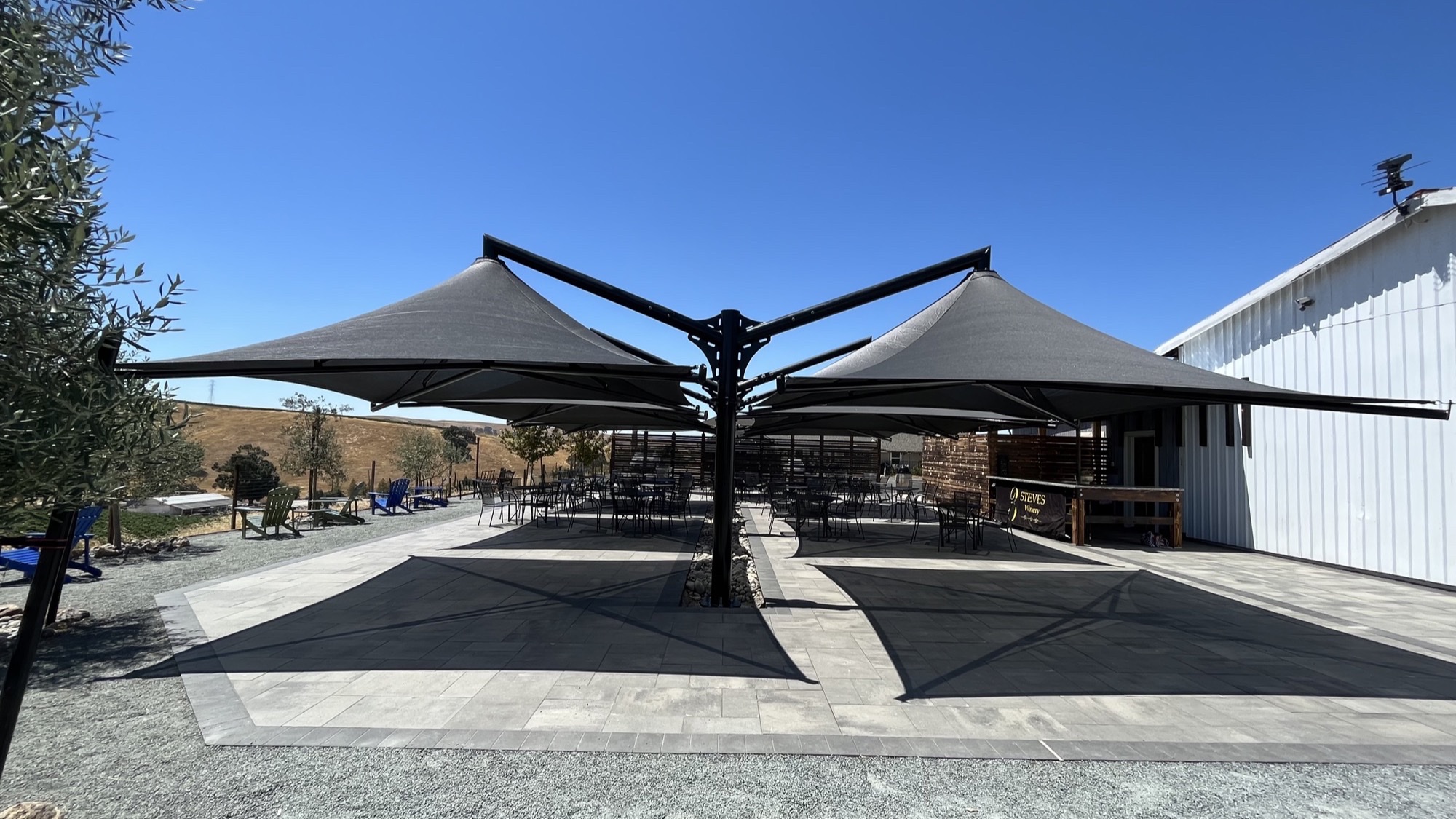
At the larger end, 13×13 through 18×18 sizes are typically specified for shared or communal coverage: a bar area, a lounge grouping, a section of a pool deck, or an outdoor classroom cluster where several tables sit under one canopy. An 18×18 canopy can shade a footprint comparable to a small pavilion, which is why properties with heavy seasonal foot traffic, such as resort pools or event lawns, often lean toward the largest sizes paired with fewer poles rather than a dense field of smaller umbrellas. The tradeoff is structural: larger canopies concentrate more wind load onto a single pole and base, so sizing up should always come with a matching upgrade in frame gauge and base weight rather than simply scaling the fabric.
A useful rule of thumb when comparing sizes across this range is to measure the actual seating footprint first, including chair pull-out space, then add roughly two feet of overhang on each side so the shade line moves with the sun through the middle of service hours. Facilities that skip this step frequently end up with umbrellas that look correctly sized on a spec sheet but leave tables in direct sun by early afternoon.
Frame Materials and Structural Specs
Frame material is the first fork in the road for any commercial patio umbrella purchase. Powder-coated aluminum is the most common choice because it resists corrosion in coastal and poolside environments where chlorine and salt air degrade untreated steel quickly. Marine-grade or hot-dip galvanized steel frames offer higher stiffness for larger canopies and higher wind zones, at the cost of more weight to move and, without a quality coating, more corrosion risk over time.
Rib construction is the second variable. Extruded aluminum ribs with reinforced joints hold their shape under wind loading better than thin stamped ribs, which is the difference between a canopy that flexes and sheds wind and one that inverts. Auto-tilt and crank-lift mechanisms add convenience for daily opening and closing, but the mechanism itself should be rated for the umbrella’s size; an undersized crank on an 18×18 unit will wear out well before the fabric does. Vented canopy tops, which allow wind to pass through a small opening at the crown rather than catching the full canopy like a sail, are a common feature on higher-end units for exactly this reason.
Canopy Fabric, Wind Ratings, and UV Protection
Canopy fabric is where a lot of commercial patio umbrellas are quietly downgraded to cut cost. Solution-dyed acrylic fabrics carry color all the way through each fiber rather than as a surface coating, which means the color resists fading far longer under the same UV exposure as a printed or surface-dyed alternative. Commercial buyers should ask specifically about fabric weight and UV rating rather than assuming all “outdoor fabric” performs the same; a lightweight decorative fabric and a true commercial-grade canopy can look identical on a showroom sample and perform very differently after a full season outdoors.
Wind rating is the other number worth confirming before purchase. Structural wind engineering for outdoor shade generally follows the load principles in ASCE 7, the wind load standard engineers use to calculate how much force a structure needs to withstand for its size and location. Reputable manufacturers will state a wind rating on their units or, at minimum, be able to point to engineering behind the frame and base combination. A property in a coastal or high-wind zone needs a meaningfully different spec than a sheltered courtyard, even if both are ordering the same 12×12 size on paper.
Base and Mounting Options for Commercial Installations
How a commercial patio umbrella is anchored matters as much as the canopy itself. In-ground sleeve mounts, where a steel sleeve is set in concrete below the patio surface, offer the most permanent and wind-resistant installation and are common for properties that keep theirs up year-round. Surface mounts bolt directly to an existing concrete or paver patio, which suits retrofits where excavation is not practical, provided the mounting plate and hardware are sized to the umbrella’s wind load.
Portable ballasted bases, filled with sand, water, or poured concrete weights, give a facility the flexibility to reposition or seasonally store its umbrellas, which appeals to properties that host events or need to reconfigure seating layouts. The tradeoff is capacity: a ballasted base has to be heavy enough to counter the wind load of the specific canopy size, and undersized bases are one of the most common reasons a unit tips over in a storm. Offset or cantilever-style commercial patio umbrellas, which move the pole out of the seating footprint entirely, solve a different problem: keeping the base clear of table and chair traffic in tight patio layouts, at the cost of a larger and heavier counterweight system to balance the offset load.
Ongoing maintenance is part of the base and mounting decision, not a separate afterthought. In-ground and surface-mounted units generally need little more than periodic hardware inspection, while portable ballasted bases need their weight checked seasonally since sand and water ballast can settle, evaporate, or need topping off. Canopy fabric should be closed or removed ahead of forecast high winds regardless of mounting type, and facilities in freeze-thaw climates typically close or store fabric over winter to avoid ice load on the frame. Building a short seasonal checklist, tied to whoever manages grounds or maintenance, keeps a fleet of umbrellas across a property from becoming an inconsistent patchwork of open and closed units.
Facility-by-Facility Buying Considerations
Restaurants and outdoor dining venues generally want commercial patio umbrellas sized to individual tables, in the 8×8 to 10×10 range, with a consistent fabric color across the patio for a cohesive look; a broader look at patio shade strategy is covered in our guide to outdoor dining shade structures for restaurants. Hotels and HOAs managing pool decks tend to favor a mix of sizes, larger 13×13 to 18×18 units over communal lounge groupings and smaller ones over individual chaise pairs, with a strong preference for corrosion-resistant frames given constant chlorine and moisture exposure.
Office campuses and employee break areas typically standardize on a single mid-size commercial patio umbrella, often 10×10 or 11×11, repeated across several courtyard tables, which keeps furniture and fabric replacement simple down the line; see our companion guide on employee break area shade structures for more on that use case. Municipalities and school districts covering plazas, quads, and cafeteria overflow seating usually need the largest units in the lineup paired with tamper-resistant hardware, since these are high-traffic public spaces where furniture and shade structures see less supervised use than a private restaurant patio.
Retail centers and mixed-use developments occupy a middle ground: outdoor seating near a food hall, a plaza fountain, or a shared courtyard needs to read as an amenity rather than a maintenance liability, which usually pushes the spec toward mid-to-large units with a color and finish that ties into the property’s existing signage and storefront palette. Property managers overseeing several of these common areas often standardize a single frame color and fabric line across the site so that replacement units, whenever they are eventually needed, match without a special order.
Common Buying Mistakes and Cost Drivers
The most frequent mistake with commercial patio umbrellas is treating them as furniture rather than structures. A consumer-grade umbrella purchased because it was available faster or cheaper will not hold up to daily commercial use, and the replacement cost of doing it twice usually exceeds the price gap of buying commercial-grade the first time. A close second is undersizing the base or ballast for the canopy size chosen; this is the single most common cause of tip-overs and warranty claims on these installations. A third common error is ignoring fabric grade in favor of color selection alone, which leads to visibly faded canopies within a year or two in high-UV climates.
On cost, commercial patio umbrellas span a wide range depending on the variables above. As industry-typical market context, smaller 8×8 to 9×9 commercial-grade units commonly start in the low hundreds of dollars per umbrella, while larger 13×13 to 18×18 units with reinforced frames, premium fabric, and engineered bases can run well into four figures each before bases, delivery, and installation. Cantilever and offset designs generally carry a premium over center-pole umbrellas of the same canopy size because of the counterweight engineering involved. These figures are market ranges only, not a quote; the right number for a specific property depends on size, quantity, fabric, base type, and site conditions, which is best worked out with a site-specific quote rather than a catalog price.
How Custom Canopies Builds Commercial Patio Umbrellas In-House
Custom Canopies Inc. is a family-owned, made-in-America manufacturer that keeps engineering, fabrication, and powder coating in-house rather than outsourcing pieces to third parties, which matters here because frame, coating, and canopy all need to be matched to the same wind and use profile. The process runs through six steps: Consultation, where the facility’s seating layout, size range, and site conditions are reviewed; Drafting, where specific sizes and base types are laid out for the property; Manufacturing, where frames are fabricated to the project spec, including sizes from 8×8 up to 18×18; Coating, where frames receive in-house powder coating for corrosion resistance and color matching; Shipping; and Installation. Because sizing is done to the nearest inch rather than off a fixed catalog, a property with an irregular patio footprint or a specific seating count can get units dimensioned to the actual space instead of forcing a standard size to fit. More on this approach to specification and layout is available on the commercial design page, and the full umbrella product line, including 8×8 through 18×18 sizes, is detailed on the commercial patio umbrellas page.
Custom Canopies Inc. holds Contractors License #880322 and Fabricators License #FB00073, and ships and installs commercial patio umbrellas anywhere in the United States, which matters for multi-site restaurant groups, hotel portfolios, or municipal contracts that need consistent specification across several locations rather than relying on a different regional vendor for each site.
Frequently Asked Questions
What size commercial patio umbrella do I need for a standard four-top table?
An 8×8 to 9×9 unit typically covers a standard four-top table with enough overhang for chair movement. Larger tables or six-tops generally call for a 10×10 or 11×11 size.
Can commercial patio umbrellas be left up year-round?
Properties in milder climates often leave them up year-round when the frame, fabric, and base are rated for continuous outdoor exposure. In regions with severe winter storms or hurricane risk, closing and securing the canopy during extreme weather is standard practice regardless of its rating.
What is the difference between a center-pole and a cantilever commercial patio umbrella?
A center-pole design has its support pole running through the middle of the seating area, while a cantilever or offset design moves the pole to the side, keeping the space beneath the canopy completely clear of furniture obstructions.
How do I know if a commercial patio umbrella base is heavy enough?
Base weight requirements scale with canopy size and local wind exposure, which is why manufacturers publish minimum ballast weights per size. A site-specific review, rather than a generic base recommendation, is the reliable way to confirm adequate holding power for a given location.
Do commercial patio umbrellas need to meet ADA requirements?
The umbrella itself is not an ADA element, but the seating and pathways underneath and around it need to maintain accessible clearances and routes, which is worth reviewing alongside broader accessible seating planning; see ADA.gov for federal accessibility guidance.
What fabric holds up best on commercial patio umbrellas in high-sun climates?
Solution-dyed acrylic fabrics generally outperform surface-dyed or printed alternatives because the color is embedded through the fiber rather than applied as a coating, which slows visible fading under sustained UV exposure.
Can commercial patio umbrellas be custom sized instead of using standard dimensions?
Yes. Manufacturers with in-house engineering and fabrication can size these units to the nearest inch for an irregular patio footprint, rather than limiting a property to fixed catalog sizes between 8×8 and 18×18.
How often should commercial patio umbrella canopies be replaced?
Fabric on well-specified units commonly holds color and structural integrity for several years of daily outdoor use before replacement is needed, though climate, UV exposure, and fabric grade all affect the actual timeline for a given property.
How should commercial patio umbrellas be maintained?
Routine care includes rinsing fabric to prevent dirt and mildew buildup, checking hardware and ballast weight seasonally, and closing canopies ahead of forecast high winds or freezing conditions to protect the frame and fabric between uses.
Get a Commercial Patio Umbrella Quote
Commercial patio umbrellas only pay off when the size, frame, fabric, and base are matched to the actual property, not pulled from a generic catalog listing. Custom Canopies Inc. handles consultation, drafting, manufacturing, coating, shipping, and installation in-house, with sizes from 8×8 to 18×18 built to the nearest inch for the seating layout in front of you. For answers to more specification questions, visit the FAQ page, or call (562) 464-4646 or visit the contact page to get a site-specific quote for your property.
Free Project Quote
What type of project is this?
Tell us where the shade structure is going and a specialist will design around your site.
Free Project Quote
Tell us about your project
A sentence or two is plenty. Size, location, and timeline help us quote faster.
Free Project Quote
Where should we send your quote?
A shade specialist will review your project and reach out within 1 business day.
Thanks! We’ll be in touch shortly.
A shade specialist will review your project and reach out within 1 business day. Prefer to talk now? Call (562) 464-4646.