Auto Dealership Display Lot Canopies: A Commercial Buyer’s Guide
Auto dealership display lot canopies solve a problem that most shade projects never have to think about: the structure has to protect six-figure inventory without hiding it. A playground canopy can block a little sky and nobody minds. A dealership canopy that blocks sightlines to the front row of vehicles is a canopy that costs sales, even if it does a perfect job of stopping sun and hail damage. For facilities managers, dealer principals, and procurement teams planning a display lot upgrade, that tension between protection and visibility is the whole design problem, and it is worth getting right before steel goes into the ground. Dealer groups evaluating auto dealership display lot canopies for the first time often start the conversation with hail or heat damage and end up discovering that the bigger design question is layout, not fabric or steel gauge.
This guide walks through what auto dealership display lot canopies actually need to do, how to plan column placement and bay widths so shade does not compete with merchandising, the structural and compliance angles that matter for large spans, and the buying mistakes that show up again and again on dealership projects.
What Are Auto Dealership Display Lot Canopies?
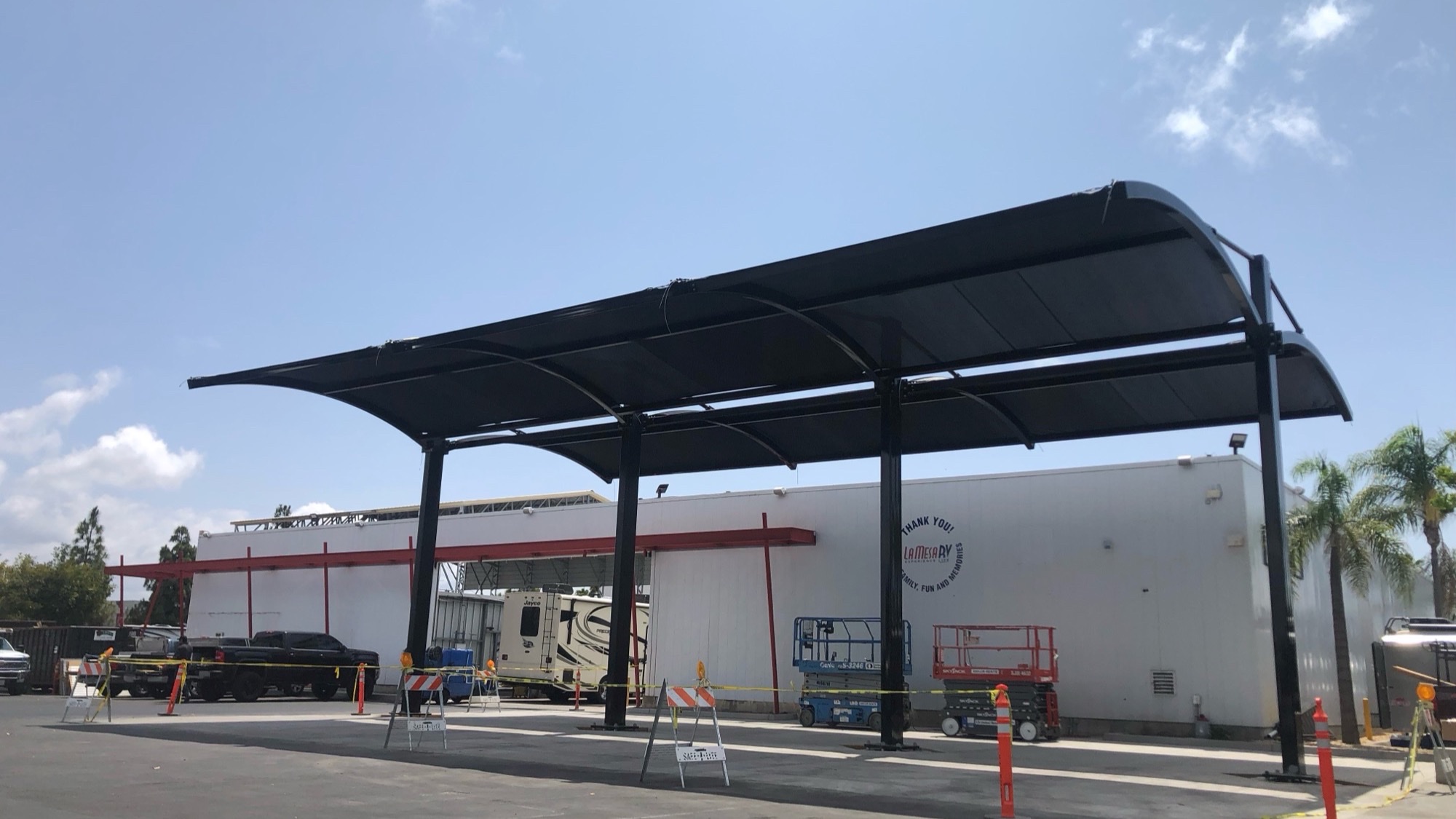
Auto dealership display lot canopies are engineered shade structures built specifically to cover the inventory rows where vehicles sit for sale, as opposed to structures over service drives, customer parking, or employee lots. The distinction matters because the design priorities are different. A service drive canopy is built around clearance for vehicles moving in and out, technicians working underneath, and weather protection during intake. A display lot canopy is built around merchandising: every post, beam, and footing has to be placed so it does not block a customer’s first look at a vehicle from the street, the showroom, or the entry drive. Most dealership display lot canopies use a cantilever or widely spaced post-and-beam design precisely because cantilever framing keeps support columns out of the sightline between rows. Four-post or center-column designs are cheaper per square foot but tend to plant a post exactly where a customer would otherwise be looking at a windshield sticker or a hood ornament, which is why they are less common on front-row display inventory.
Why Display Lot Shade Is a Sales and Asset-Protection Issue
Dealership inventory sitting outside year-round takes a beating that most procurement teams underestimate until they see the paint fading and the interior cracking. UV exposure degrades clear coat, fades vinyl and leather interiors, and accelerates tire sidewall cracking, all of which show up as condition issues on a car that has never been driven off the lot. Hail is the more dramatic risk: a single hailstorm can put dozens of vehicles into the body shop at once, and insurance deductibles on a hail event rarely cover the full cost of repainting or replacing hoods and roofs across an entire inventory row. A well-placed auto dealership display lot canopy is a hedge against both slow degradation and sudden catastrophic loss. There is also a customer-facing side to this. A shaded display lot is a more comfortable place to shop, and comfortable shoppers spend more time looking at vehicles instead of retreating to the showroom. Dealers who have added shade over front-row inventory routinely report that customers linger longer outside, which matters when the goal is getting someone to open a door and sit in the driver’s seat. Shade structures also protect the sales staff who spend their shift outside greeting walk-up traffic, which is a facilities and liability consideration that is easy to overlook when the project is framed purely as inventory protection. There is a resale and warranty angle worth flagging to ownership as well. Faded exterior paint and sun-cracked dashboards on a vehicle that has never left the lot are the kind of condition issues that show up on a pre-delivery inspection and either cost a reconditioning dollar amount or get negotiated off the price at the point of sale. Over a full inventory turn, the cumulative reconditioning cost on an unshaded lot in a hot or hail-prone market can add up to a meaningful line item, which is part of why dealer groups increasingly treat a display lot canopy as a facility investment with a measurable return rather than a cosmetic upgrade.
Layout Planning: Columns, Bay Widths, and Front-Row Visibility
Layout is where most of the value or the regret in an auto dealership display lot canopy project gets locked in. A few planning principles that consistently work on real dealership sites: Start from the merchandising plan, not the structural grid. Walk the lot with the general manager or used car director and mark exactly where the hero vehicles, the front-row flex inventory, and the overflow rows will sit, then design the canopy around that plan rather than forcing the merchandising to fit a standard bay spacing. Favor cantilever framing on street-facing rows. Keeping columns off to one side, or using a single center spine with cantilevered arms reaching over the vehicles, removes the visual obstruction that a traditional post grid creates. This is the single biggest design lever for protecting sightlines. Size bay widths to vehicle rows, not round numbers. Most display rows run in multiples of a single parking stall width, typically 9 to 10 feet per space. Bay widths and column spacing should be planned around the actual row count and stall width on the site survey rather than a generic structural module, so columns land in gaps between rows instead of inside them. Plan for clearance above the tallest inventory. Full-size trucks, vans, and SUVs with roof racks need more vertical clearance than a sedan row, and a canopy height that works for a compact car row will not work once a dealer rotates in a row of trucks. Our commercial design process accounts for the tallest vehicle type a lot is likely to display, not just what is parked there on survey day. Coordinate with lighting and signage. Dealership lots are lit for evening traffic and often carry pole banners, flags, or price placards. Canopy height and beam placement need to clear existing light poles and any planned signage so the shade structure does not create new dark zones or block illuminated displays after dark. Keep walking paths clear and compliant. Customers move between rows on foot, often with a salesperson, and any walkway running under or alongside a display lot canopy should keep clear, unobstructed width and a stable, slip-resistant surface. Accessibility guidance published under the Americans with Disabilities Act is a useful baseline for path-of-travel width and surface requirements when a canopy footing or column placement sits near a customer walkway.
Wind Engineering and Structural Requirements for Large Canopy Spans
Dealership display canopies tend to be larger and more open than a typical parking shade structure, which puts more emphasis on wind engineering. A canopy spanning multiple rows of vehicles behaves like a large sail in high wind if it is not properly engineered, and a structural failure over an inventory row is a worst-case outcome: the structure that was supposed to protect the vehicles instead damages them. Commercial shade structures should be engineered to local wind load requirements with stamped drawings from a licensed structural engineer, accounting for the specific wind zone, exposure category, and footing depth of the site. Engineering standards published by organizations such as ASTM International inform how wind loads, fabric tension, and connection hardware are specified for structures like these, and any reputable fabricator should be able to speak to how their designs meet the applicable building code for the jurisdiction. For coastal dealerships or sites in hurricane-prone regions, this gets even more important, since a canopy rated for inland wind exposure is not automatically rated for coastal gusts. Footing design matters just as much as the steel above ground. Display lots often sit on existing asphalt or concrete that was not engineered for new point loads, so footing depth and placement need to account for underground utilities, drainage, and the load-bearing capacity of the existing pavement section. This is also why a proper site survey, not a desktop estimate, should come before any footing plan is finalized. Once installed, a dealership display lot canopy is not a maintenance-free asset. Fastener torque, fabric tension, and footing condition should be checked on a regular schedule, particularly after a severe wind or hail event, since a structure that absorbed a major storm load is worth inspecting even if no damage is visible from the ground. Facilities teams that fold canopy inspection into their existing seasonal maintenance walkthroughs catch loose hardware and fabric wear long before it becomes a structural issue.
Materials and Coatings for Coastal, Desert, and Hail-Prone Markets
Dealership canopies get selected for climate as much as for appearance, because the steel frame and fabric both have to survive the same conditions the vehicles underneath them are being protected from. Powder-coated steel is the standard frame finish for commercial display lot canopies because it resists chipping and corrosion better than paint, and it holds up to the washing and detailing activity that happens constantly on an active dealership lot. Coastal dealerships near salt air should ask specifically about corrosion-resistant coating systems and hardware, since standard coatings can underperform within a few years in a marine environment. Desert and high-UV markets put more stress on fabric membranes, so fabric selection should account for UV degradation over the structure’s expected service life, not just initial appearance. Hail-prone regions add another layer to the material conversation. While no canopy fabric stops hail the way a solid roof does, a well-tensioned, properly engineered shade membrane over the most vulnerable rows meaningfully reduces direct hail impact on hoods and roofs, which is often the deciding factor for dealers in hail alley markets who are weighing the investment against their insurance claims history.
Facility-Type Differences: New Car, Used Car, and Powersport Display Lots
Not every dealership display lot canopy needs the same specification, and facility type changes several of the decisions above. New car dealerships tend to prioritize appearance and brand presentation alongside protection, since franchise agreements often come with facility image standards that a shade structure needs to work within. Column spacing, beam profile, and even frame color on a new car display canopy may need sign-off from a brand standards team in addition to the dealer principal, so that conversation should happen early in the design process rather than after drawings are finalized. Used car and independent dealership lots generally have more design flexibility but often carry a wider mix of vehicle heights and sizes across the same row, since used inventory is not standardized the way a single new car brand’s lineup is. Canopy clearance on a used car lot should be planned around the tallest vehicle the dealer realistically stocks, such as a lifted truck or a cargo van, rather than the average height across inventory. RV, powersport, and specialty vehicle dealerships have the most demanding clearance requirements of the group. RVs and travel trailers can run well above standard vehicle height, and powersport dealers displaying boats, ATVs, or trailers often need wider bay spacing to accommodate towing hitches and overhang. These lots benefit most from a site-specific survey rather than a standard dealership canopy template, since a structure sized for sedans and trucks will not clear an RV roofline.
Custom Canopies’ In-House 6-Step Process for Dealership Canopies
Custom Canopies Inc. is a family-owned, made-in-America manufacturer that keeps engineering, fabrication, and powder coating in-house, which matters for a dealership project where layout, structural, and finish decisions all need to stay coordinated under one roof instead of across multiple subcontractors. The process runs in six steps: Consultation, where the site and merchandising plan get walked and measured; Drafting, where column placement and bay widths get engineered around the actual inventory layout; Manufacturing, where the steel frame is fabricated to custom sizing down to the nearest inch rather than a stock module; Coating, where the powder coat finish is applied in-house for consistency and durability; Shipping, since the company ships anywhere in the US; and Installation, which can be coordinated nationally rather than handed off to a regional subcontractor who was not involved in the design. Custom sizing to the nearest inch is particularly relevant for a display lot canopy, since dealership rows rarely line up to a standard structural grid.
Buying Mistakes to Avoid When Shading a Display Lot
A few mistakes come up repeatedly on auto dealership display lot canopy projects: Designing the structure before the merchandising plan is finalized. If the canopy grid gets locked in before the dealer principal has decided where the hero inventory will sit, the structure often ends up fighting the merchandising instead of supporting it. Choosing a post-and-beam grid for street-facing rows. A standard four-post module is less expensive upfront, but on the rows that face the street or the showroom, a blocked sightline is a recurring cost every single day the canopy stands. Skipping a proper wind and footing engineering review to save time. Dealership canopies are large, open structures over valuable assets, and cutting corners on structural review is the one place where a shortcut can turn into a liability. Treating the canopy as a one-time inventory fix instead of a long-term facility asset. Dealership lots rotate inventory constantly, and a canopy designed only around today’s vehicle mix can become a poor fit if the lot shifts toward taller trucks and SUVs or a different row configuration. Not coordinating with existing site infrastructure. Light poles, drainage, utility lines, and signage all need to be part of the canopy site survey, not an afterthought discovered during footing excavation.
What Drives the Cost of an Auto Dealership Display Lot Canopy
Pricing on dealership display lot canopies varies widely by market, but a few factors consistently move the number more than others: total covered square footage, cantilever versus post-and-beam framing (cantilever designs generally cost more per square foot because of the engineering required to carry an unsupported span), wind zone and seismic requirements for the site, footing conditions on existing pavement, fabric and coating selection for the local climate, and the complexity of coordinating installation around an active, open dealership lot. Because every one of these variables changes with the specific site and inventory layout, the most reliable way to get an accurate number is a site-specific quote rather than a generic per-square-foot estimate pulled from a different market or project type.
Frequently Asked Questions
Do auto dealership display lot canopies need to be engineered differently than parking lot shade structures?
Not fundamentally, but display lot canopies are more likely to use cantilever framing to protect sightlines, and they are often sized larger and more open than a typical employee or customer parking lot shade structure, which puts more weight on wind engineering and footing design.
Can a canopy actually prevent hail damage to dealership inventory?
A properly engineered canopy over display rows significantly reduces direct hail impact on hoods, roofs, and windshields, which is why dealers in hail-prone regions often prioritize shade investment over other facility upgrades after a claims-heavy season.
Will a display lot canopy block customer sightlines to the vehicles?
It does not have to. Cantilever designs, careful column placement tied to the actual row layout, and bay widths sized to vehicle stalls rather than a generic grid all keep structural posts out of the customer’s line of sight to the inventory.
How tall do dealership display lot canopies need to be?
Clearance should be planned around the tallest vehicle type the lot is likely to display, including trucks, vans, and SUVs with roof racks, not just the vehicles on the lot at the time of the site survey.
Do these canopies need a structural engineer’s stamp?
Yes. Any commercial shade structure of this size should carry stamped engineering drawings specific to the site’s wind zone and exposure category, and a reputable fabricator should be able to walk through how the design meets local building code.
What finish holds up best for a dealership lot near the coast?
Powder-coated steel with a corrosion-resistant coating system is the standard choice, and coastal dealerships should specifically ask about hardware and coating performance in salt air, since standard finishes can underperform faster in a marine environment.
Can an existing dealership lot’s pavement support new canopy footings?
It depends on the pavement section and what utilities run beneath it, which is why a site survey and footing engineering review should happen before any layout is finalized rather than after.
Get a Site-Specific Quote for Your Dealership Display Lot
Auto dealership display lot canopies only work when the layout, structural engineering, and merchandising plan are designed together from the start. Custom Canopies Inc. handles consultation, drafting, manufacturing, powder coating, shipping, and installation in-house, with custom sizing to the nearest inch and national service to any dealership site in the US. Call (562) 464-4646 or visit our contact page to start a site-specific quote for your dealership’s display lot.
Free Project Quote
What type of project is this?
Tell us where the shade structure is going and a specialist will design around your site.
Free Project Quote
Tell us about your project
A sentence or two is plenty. Size, location, and timeline help us quote faster.
Free Project Quote
Where should we send your quote?
A shade specialist will review your project and reach out within 1 business day.
Thanks! We’ll be in touch shortly.
A shade specialist will review your project and reach out within 1 business day. Prefer to talk now? Call (562) 464-4646.