Shade Structure Fabric Colors for Schools: A District Buyer’s Guide
Choosing shade structure fabric colors for schools is rarely as simple as matching a mascot. Facilities directors, procurement teams, and architects juggling a bond-funded campus improvement have to balance heat performance, UV block, fade resistance over a ten-year service life, and district branding standards, all inside a DSA approval process that does not care how good a color looks on a rendering. Get the fabric color decision wrong and a district can end up with a canopy that fades within a few summers, absorbs more heat than the alternative it replaced, or triggers a resubmittal because the color spec was not documented the way DSA reviewers expect. This guide walks through how shade structure fabric colors for schools actually perform, where districts commonly go wrong, and how to make a color decision that still looks right in year eight. It also breaks the decision down by facility type, since the right shade fabric color for an elementary play structure is not automatically the right choice for a stadium concourse or a district administration entry.
What Fabric Color Selection Actually Involves
On paper, choosing shade structure fabric colors for schools looks like picking a swatch from a manufacturer’s catalog. In practice it is a specification decision with downstream effects on thermal comfort, warranty life, and how the finished structure reads against existing campus buildings. Commercial shade fabric, whether knitted HDPE mesh for shade sails or a heavier vinyl-coated fabric for a tensioned canopy, is manufactured in a fixed range of stock colors plus a smaller set of premium or custom-dyed options. Each color carries its own published shade factor, UV block rating, and heat-gain profile, and those numbers vary enough between colors that they belong in the same conversation as span, height, and wind load.
For a district, that means the fabric color line item on a shade structure quote is not cosmetic. It affects surface temperature under the canopy, how the structure ages against Southern California or Southwest UV exposure, and whether the finished project satisfies a board-approved branding guideline that specifies exact colors for anything visible from the street. Treating color as an afterthought after span and footing design is finalized is one of the most common ways districts end up re-opening a decision late in the process.
Why Color Choice Matters More on Commercial Campuses Than People Expect
A single-site commercial property picking a shade sail color has one property manager’s preference to satisfy. A school district picking shade structure fabric colors for schools is answering to a facilities master plan, a bond oversight committee, an architect of record, and often a DSA reviewer, all at once. That is a different scale of decision, and it carries different stakes.
First, districts typically install shade structures in phases across many sites over several years. A color chosen for one campus becomes the de facto standard the next site is compared against, whether or not that was the intent. Second, shade structures over play areas, courtyards, and outdoor learning spaces are some of the most visually prominent capital improvements a district makes, often more visible from the street than a roofing project. Third, and most practically, fabric color interacts directly with two things every facilities director cares about: student comfort during peak heat hours and how long the fabric lasts before it needs replacing. A color that looks sharp in a rendering but fades unevenly by year four becomes a maintenance conversation the district did not budget for.
UV Protection and Heat Performance by Fabric Color
Darker shade fabrics, particularly navy, black, and forest green, generally block a higher percentage of UV radiation and produce deeper, higher-contrast shade. That makes them a common choice for play structures and outdoor eating areas where UV block is the priority. The tradeoff is heat: darker fabrics absorb more solar energy and can run warmer to the touch and radiate more heat into the shaded area during peak afternoon hours, particularly in low-airflow courtyards.
Lighter fabrics, such as white, sand, and light gray, reflect more solar energy and typically keep the space underneath several degrees cooler in direct comparison, which is why they show up often on hot-climate campuses in Arizona, Texas, and the Central Valley. The tradeoff runs the other direction: lighter colors show soiling, water staining, and bird activity more visibly between cleanings, and many lighter commercial fabrics carry a slightly lower published UV block percentage than the darkest options in the same product line, though the difference is usually small enough that it should not be the deciding factor on its own.
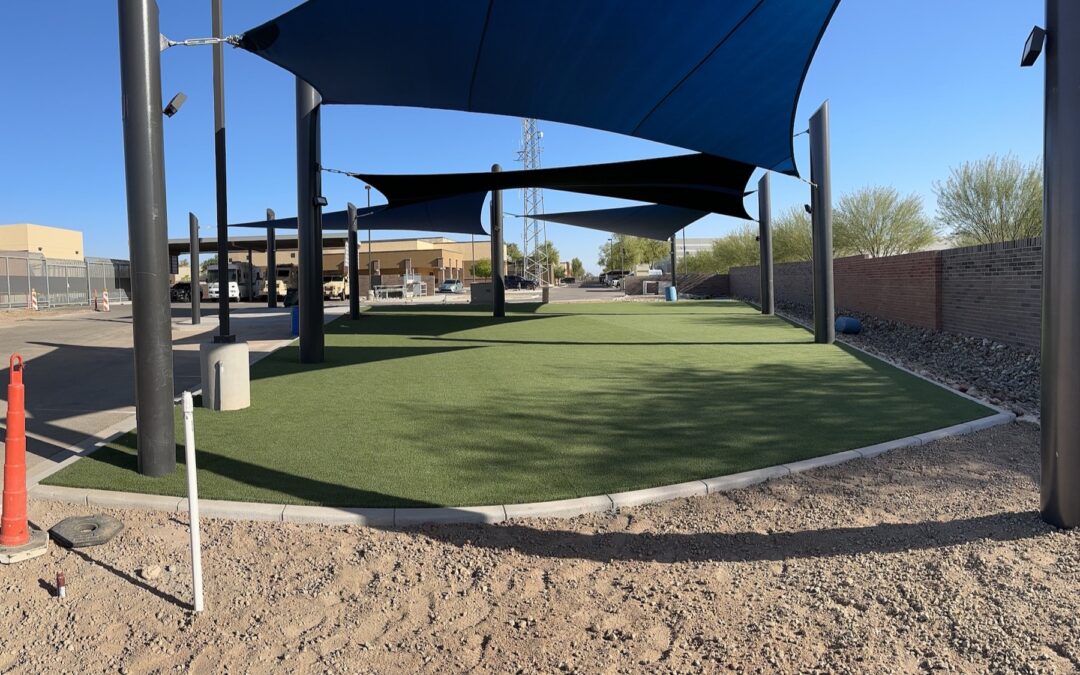
Mid-tone colors, blues, teals, and grays in particular, are the most common landing spot for districts precisely because they split the difference: solid UV performance, moderate heat absorption, and better visual forgiveness of dust and light staining than white. When a district asks which color performs best, the honest answer is that performance is a spectrum from dark to light, and the right point on that spectrum depends on the climate zone and how exposed the site is, not a single universally correct color.
Fade Resistance and Long-Term Color Retention
Every commercial shade fabric fades under sustained UV exposure eventually; the question a district should be asking is how evenly and how slowly. Solution-dyed fabrics, where color pigment is added to the fiber before it is extruded rather than applied as a surface coating afterward, hold color more consistently over time than surface-dyed alternatives and are the standard specification for any structure expected to stay in service for a decade or more.
Color family affects perceived fade as much as actual UV degradation does. Saturated, deep colors like navy, burgundy, and hunter green show fading as a visible shift, sometimes uneven across the panel if one edge gets more direct exposure than another, which reads to a facilities visitor as an aging structure even when the fabric is still within its rated UV-block life. Lighter and mid-tone colors tend to fade less conspicuously because the shift in shade is less visually dramatic. Districts specifying a saturated custom color to match team branding should budget for a visibly different-looking structure well before its functional end of life, and should factor that into replacement planning rather than treating fade as a defect.
Matching District and School Colors Without Sacrificing Performance
Matching school colors is one of the most common reasons a district reaches out to us in the first place, and it is achievable without defaulting to whichever stock color looks closest. Most commercial fabric manufacturers offer a broad-enough stock palette that districts can usually get within a shade or two of an official school color using an off-the-shelf option, which keeps lead times and costs predictable. When a stock color is not close enough, some fabric lines support custom or made-to-order color matching against a Pantone reference, at added lead time and typically a per-yard premium, which is worth requesting a quote on separately from the base structure price.
A practical approach that works across an elementary, middle, and high school portfolio: use the district’s primary color as the dominant sail or canopy color where UV performance allows it, and reserve the secondary or accent color for trim, valances, or a smaller secondary sail rather than trying to force a bright accent color across an entire large-span structure, where heat performance and fade visibility both suffer. This keeps the branding intent intact while letting the performance-driving color decisions happen on the largest fabric areas. For elementary campuses where play structures sit under the canopy, prioritizing UV block and heat performance over an exact color match is usually the right call, since the audience underneath is young children in direct, sustained exposure. For a district office, stadium, or administration building entry, where the structure functions more as a branding statement, an exact color match carries more weight relative to performance.
Facility-Type Breakdown: Playgrounds, Courtyards, Stadiums, and District Offices
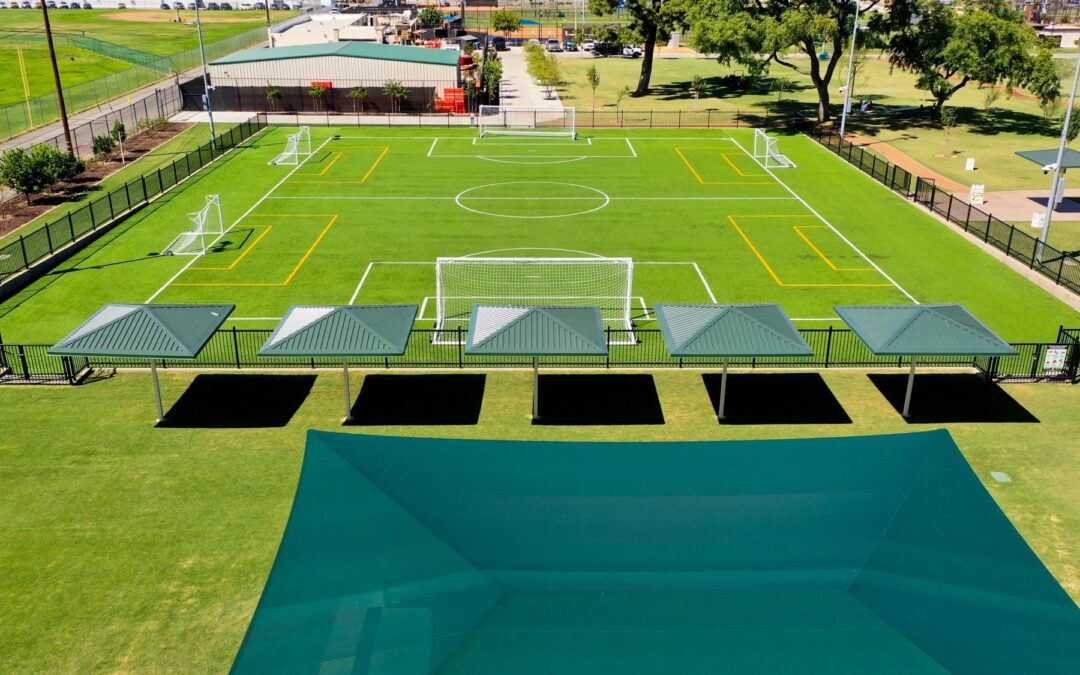
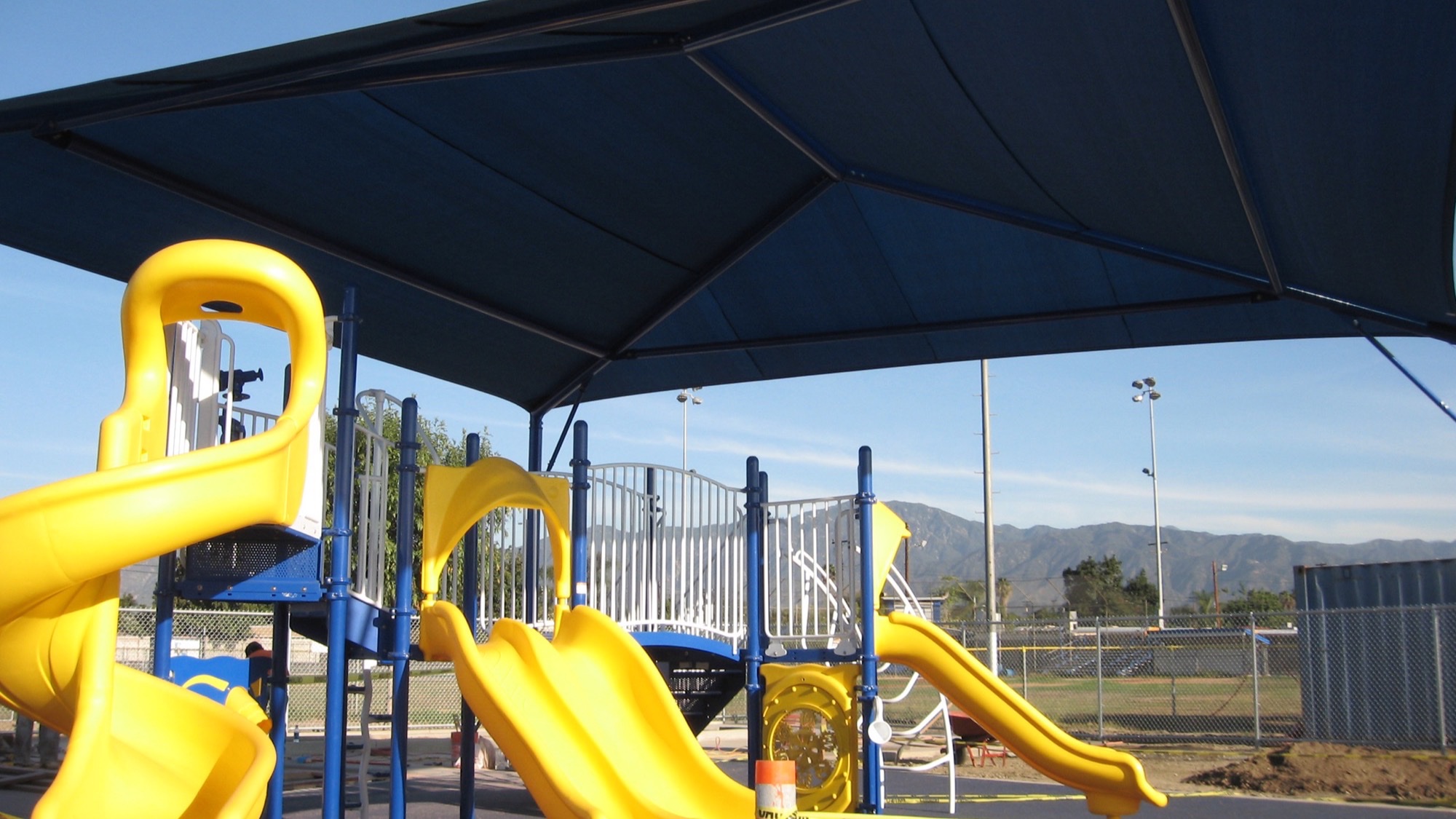
A district planning shade structures across multiple facility types benefits from thinking about fabric color one site category at a time rather than settling on a single answer for the whole portfolio. Elementary and middle school playgrounds see the heaviest, most sustained midday sun exposure and the highest concentration of young children directly under the fabric, which makes UV block and heat performance the priority. Mid-tone blues and grays, or darker colors in climates without extreme heat concerns, tend to be the safer default here, with district branding treated as a secondary consideration layered in through frame color or a smaller accent panel.
Outdoor eating areas and courtyards carry a similar performance priority but add a durability wrinkle: food service areas see more airborne grease and organic staining than a play structure, which argues against very light fabric colors that show soiling quickly between cleanings. Athletic facilities, including stadium concourses, bleacher shade, and team bench canopies, are usually where districts push hardest for exact color matching to team colors, and it is a reasonable place to do it, since these structures typically see shorter, more seasonal exposure windows than a playground canopy that runs shade duty all day, every school day, for years. District office entries and administration buildings function more as a branding statement than a heat-management structure, so an exact custom color match is often worth the added lead time and cost in a way it may not be for a play yard shade sail that needs to hold up to a decade of daily UV exposure.
Compliance, Safety, and DSA Considerations for Color and Fabric Selection
Fabric color itself is not typically a life-safety item under California’s Division of the State Architect review, but the fabric specification it is attached to absolutely is. Flame-spread rating, fabric weight, and manufacturer certification data all need to be documented as part of a DSA-approved shade structure submittal, and swapping a fabric color after DSA approval, if it changes the underlying fabric product or manufacturer, can trigger a resubmittal even when the structural design does not change. The practical guidance here is straightforward: finalize the fabric color as part of the original DSA submission package rather than treating it as a change order after drawings are stamped.
Glare is the other compliance-adjacent consideration districts sometimes miss. Very light, reflective fabric colors near hard surfaces like concrete or asphalt can increase glare in a way that affects visibility for students and staff, which is worth a site walk consideration for courtyards near ramps, stairs, or vehicle drop-off zones where the Americans with Disabilities Act accessibility standards for the built environment intersect with everyday safety. None of this rules out light colors; it just means a facilities team should think about color and site layout together rather than in isolation.
How Custom Canopies Approaches Fabric Color on School Projects
Because Custom Canopies handles engineering, fabrication, powder coating, and installation in-house rather than outsourcing pieces of the job, fabric color decisions get made early and stay consistent through the full project instead of getting lost between subcontractors. Our process runs through six stages: consultation, drafting, manufacturing, coating, shipping, and installation. Fabric color and frame powder coat color are both locked in during the consultation and drafting stages, alongside span, height, and structural design, so the color a district approves on paper is the color that ships. Structures are custom-sized to the nearest inch, which means fabric panels are cut for the specific site rather than pulled from a generic stock size, giving districts more flexibility to combine a dominant color across the main span with an accent color on a secondary sail or valance without odd seams or leftover material driving the layout.
For districts weighing options across shade sails, cantilever canopies, and tensioned fabric structures, our team can walk through which fabric families and color options are available for a given structure type and climate zone before drafting begins, so color, performance, and DSA documentation are aligned from the start rather than reconciled after the fact.
Common Buying Mistakes Districts Make on Fabric Color
The same handful of mistakes show up repeatedly across district shade structure projects. Picking a color purely from a small swatch or a screen rendering is the most common; fabric color reads very differently at full scale under direct sun than it does on a six-inch sample or a monitor, and a site visit to see an installed structure in a similar color is worth the time it takes. Specifying a saturated custom color without asking about the fade-visibility tradeoff is another, particularly for districts trying to match a specific team color exactly rather than the closest strong-performing stock option.
Districts also sometimes finalize color after DSA drawings are already in review, which risks the resubmittal issue covered above. Another frequent gap is not accounting for multiple facility types in one color decision: a color chosen for a shaded play structure at an elementary campus does not automatically make sense for a high school stadium concourse or a district office entry, and treating every site the same can produce a structure that underperforms for its specific use. Finally, some districts skip asking for the fabric manufacturer’s published UV block and shade factor numbers by color, and end up comparing options based on appearance alone when the performance data is available and should be part of the decision.
What Drives Fabric Color Cost on a School Project
Stock colors within a manufacturer’s standard line typically carry no premium over one another; the cost driver is fabric type and structure size, not which stock color is chosen. Custom or made-to-order color matching against a specific Pantone reference is where cost typically increases, both in per-yard fabric pricing and in added lead time for the dye run, and multi-color designs with more than one fabric panel or a contrast valance add fabrication time versus a single-color sail or canopy. Because these figures vary by fabric manufacturer, structure size, and project timeline, the most reliable way to budget is a site-specific quote rather than a rule of thumb, which is where our FAQ page and consultation process can help districts scope options before committing to a color. Bundling color decisions across several campuses in a single bond-funded phase can also help a district negotiate more predictable fabric pricing than sourcing colors site by site, since larger combined fabric orders typically streamline the manufacturer’s cutting and dyeing runs.
Frequently Asked Questions About Shade Structure Fabric Colors for Schools
Do darker shade fabric colors block more UV than lighter colors?
Generally yes, darker fabrics tend to carry slightly higher published UV block ratings and produce more visually dense shade, but the difference between a well-made dark and light commercial fabric is often small enough that climate and heat comfort should factor into the decision as much as raw UV block percentage.
Will a dark shade sail make the area underneath hotter?
Darker fabrics absorb more solar energy and can radiate more heat into a low-airflow space than lighter fabrics, which is why hot-climate campuses often lean toward mid-tone or lighter colors for large play or gathering areas even when a dark color would match school branding more closely.
Can Custom Canopies match our exact school colors?
In most cases a stock fabric color gets within a shade or two of an official school color, and custom Pantone-matched fabric is available for districts that need an exact match, typically at added lead time and cost. Our team can review options during consultation against your district’s branding standards.
Does changing fabric color affect DSA approval?
Fabric color itself is not a structural item, but if a color change means switching fabric products or manufacturers, it can affect the certification data submitted with a DSA approval package and may require a resubmittal. Finalizing color before DSA submission avoids this.
How long does shade fabric color last before it fades noticeably?
It depends on the fabric type, color saturation, and UV exposure at the site, but solution-dyed commercial fabrics are built to hold color consistently for many years of service life. Saturated, dark custom colors tend to show visible fade sooner than mid-tone or lighter stock colors, even when both are within their rated lifespan.
Should every school in our district use the same shade fabric color?
Not necessarily. A consistent color supports district branding, but facility type, climate exposure, and the specific use of the shaded area, such as a play structure versus a stadium concourse, can justify different color choices at different sites while still staying within a district’s approved color family.
What is the most popular shade fabric color for school campuses?
Mid-tone blues, teals, and grays are among the most common choices because they balance UV performance, heat absorption, and visual forgiveness of dust and staining better than the darkest or lightest options, and they tend to read well against most district color schemes without an exact custom match.
Get a Fabric Color and Shade Structure Quote for Your Campus
Choosing shade structure fabric colors for schools does not have to mean guessing between a swatch card and a rendering. Custom Canopies handles engineering, fabrication, powder coating, and installation in-house, which means fabric color, structural design, and DSA documentation all move through the same team from consultation through installation. If your district is planning a shade structure project and needs help balancing branding, UV performance, and long-term fade resistance across one campus or a multi-site rollout, call us at (562) 464-4646 or contact us for a site-specific quote.
Free Project Quote
What type of project is this?
Tell us where the shade structure is going and a specialist will design around your site.
Free Project Quote
Tell us about your project
A sentence or two is plenty. Size, location, and timeline help us quote faster.
Free Project Quote
Where should we send your quote?
A shade specialist will review your project and reach out within 1 business day.
Thanks! We’ll be in touch shortly.
A shade specialist will review your project and reach out within 1 business day. Prefer to talk now? Call (562) 464-4646.